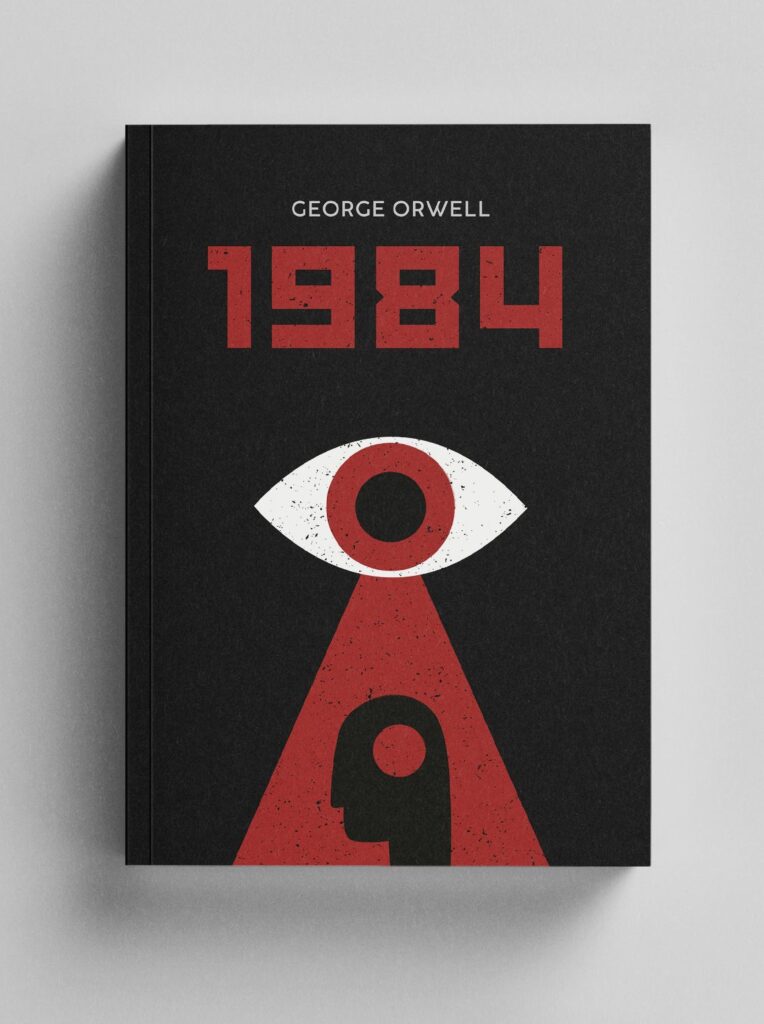
There are books that make you think, and then there are books that change the way you think forever. George Orwell’s 1984 is one such book. Every line of this haunting dystopian novel feels like a warning, whispering across time — urging readers to guard their freedom, question authority, and value truth.
In this 1984 book summary, we’ll travel through the bleak world of Airstrip One, meet Winston Smith — a man who dares to remember — and uncover how Orwell built one of literature’s most terrifying visions of total control. This isn’t just a recap of what happens in the novel; it’s a reflection on why 1984 still matters today, decades after its publication.
The World of 1984 — Where Truth Is a Lie
Before we step into Winston’s story, it’s important to understand the world Orwell created. The setting of 1984 is a grim future where the world is divided into three superstates — Oceania, Eastasia, and Eurasia. The novel primarily takes place in Oceania, a society ruled by the Party, under the omnipresent and omnipotent figure known as Big Brother.
But Big Brother isn’t just a leader; he’s a symbol — a face plastered on walls, on telescreens, and in every citizen’s mind. His watchful eyes remind everyone that you are never alone. Every action, every whisper, and even every thought can be monitored and judged. This is the age of total surveillance — and privacy is a crime.
The Party controls not only what people do but also what they think. Through mechanisms like the Thought Police, the Party ensures that even internal dissent — something as private as a rebellious thought — can be punished. “Thoughtcrime” is the gravest offense, and doublethink — the ability to hold two contradictory beliefs and accept both — becomes a survival skill.
Language, too, becomes a tool of oppression. Through Newspeak, the Party continuously shrinks the vocabulary, erasing words that could help people think critically or express dissent. After all, if there’s no word for “freedom,” can you even imagine it?
This chilling control of mind and reality is the foundation on which Orwell builds his masterpiece.
Meet Winston Smith — The Man Who Remembers
At the center of this 1984 book summary is Winston Smith, a quiet, middle-aged man who works in the Ministry of Truth. Ironically, his job is to rewrite history — altering old newspaper articles and documents to fit whatever narrative the Party currently promotes. If Big Brother says Oceania has always been at war with Eastasia, Winston must “correct” the past to make it appear so.
But deep down, Winston knows the truth: the Party lies. He knows that the past is constantly being rewritten, that facts are erased, and that memory itself is becoming unreliable. “Who controls the past controls the future: who controls the present controls the past.” This chilling slogan captures the heart of the Party’s power.
Winston’s quiet rebellion begins in the simplest way — he buys a journal and writes, “Down with Big Brother.” It’s a small act, almost absurdly simple, but in this world, it’s enough to seal his fate. That moment marks his awakening — the beginning of his fight for individuality in a world that demands conformity.
The Ministries of Control — Irony in Names
Orwell structures his dystopia around four key institutions, all of which have names that mean the exact opposite of what they do:
- Ministry of Truth (Minitrue) – Handles propaganda and historical revisionism. It manufactures lies.
- Ministry of Peace (Minipax) – Manages warfare.
- Ministry of Love (Miniluv) – Enforces loyalty through torture and fear.
- Ministry of Plenty (Miniplenty) – Oversees rationing and economic scarcity.
This linguistic irony highlights the terrifying genius of Orwell’s world. Words are twisted to mean their opposites — peace means war, love means fear, and truth means lies. It’s not just deceit; it’s systematic inversion of meaning, making language itself a weapon.
A Forbidden Love — Winston and Julia
While working at the Ministry, Winston begins to notice a young woman named Julia. At first, he suspects her of being a spy — maybe even part of the Thought Police. But one day, she slips him a secret note that simply says, “I love you.”
In a world where love itself is an act of rebellion, this message is electric. Winston and Julia begin an affair, meeting secretly in the countryside and later renting a small room above an antique shop — a rare, private space where they can be free.
Through Julia, Winston experiences something he hasn’t felt in years — hope. Julia is pragmatic and defiant. She doesn’t care about politics or ideology; she rebels by enjoying forbidden pleasures — sex, chocolate, and the simple joy of being alive.
Together, they share their hatred for the Party and dream of freedom. For the first time, Winston begins to believe that rebellion might be possible. He even imagines that they’re part of a secret resistance movement known as The Brotherhood, led by the elusive Emmanuel Goldstein.
The Book Within the Book — Goldstein’s Manifesto
In the middle of the novel, Winston gets his hands on a copy of Goldstein’s book, titled The Theory and Practice of Oligarchical Collectivism. This “book within the book” serves as Orwell’s philosophical commentary on how totalitarian systems maintain control.
Goldstein explains that societies like Oceania thrive on perpetual war because war keeps the population frightened, obedient, and distracted. The goal isn’t victory — it’s endless conflict, ensuring that citizens never question why they suffer.
He also explains that hierarchical societies survive by controlling not just actions but thought. The Party’s ultimate ambition is to make rebellion psychologically impossible. It’s a chilling analysis — and Winston devours it, finally believing he understands how the system works.
But this brief window of enlightenment soon shatters.
Betrayal and Capture
Winston and Julia’s dream of freedom ends abruptly. Their secret room turns out to be a trap. The kindly old shopkeeper, Mr. Charrington, is revealed to be an agent of the Thought Police. The lovers are arrested and dragged to the Ministry of Love — the most feared place in all of Oceania.
Here, Orwell shifts the tone from quiet rebellion to psychological horror. Winston faces O’Brien, a senior Party member he once believed was part of the resistance. But O’Brien is no rebel; he is the system itself — intelligent, persuasive, and utterly ruthless.
Through a series of brutal interrogations and tortures, O’Brien dismantles Winston’s spirit. He tells Winston that reality exists only in the mind and that the Party can control even that. “If the Party says 2 + 2 = 5, then it is so.” Truth is whatever the Party declares.
Winston tries to resist, clinging to the belief that there’s still an external reality — that the Party can’t control his mind. But as the torture continues, his resistance crumbles. He learns that love, loyalty, and individuality are all illusions under the Party’s gaze.
Room 101 — The Final Betrayal
The climax of 1984 unfolds in the dreaded Room 101, where prisoners face their greatest fear. For Winston, it’s rats. Confronted with this primal terror, he finally breaks. In his desperation, he screams, “Do it to Julia!” — betraying the only person he truly loved.
That’s the ultimate victory for the Party. Not killing Winston, but breaking his soul — turning him into a hollow shell who will obey, conform, and love Big Brother. The novel ends not with death, but with submission.
In the final scene, Winston sits in a café, drinking gin, mechanically following Party propaganda on a telescreen. When news of a military victory flashes across the screen, Winston feels tears of joy — not for truth, not for freedom, but for his devotion to Big Brother.
“He had won the victory over himself. He loved Big Brother.”
It’s one of the most chilling final lines in all of literature.
Themes Explored in 1984
Now that you’ve walked through the 1984 book summary, let’s unpack the deeper ideas that make Orwell’s novel timeless — and terrifyingly relevant even today.
1. Power and Control
The Party doesn’t seek power to do good — it seeks power for its own sake. Orwell captures this perfectly through O’Brien’s words:
“The object of power is power.”
This idea — that authority can become self-sustaining and detached from any moral purpose — remains one of the most profound warnings of the novel.
2. Truth and Reality
By constantly rewriting history, the Party turns truth into clay, shaping it at will. Orwell asks a haunting question: What happens when objective truth no longer exists?
In today’s world of misinformation and social media manipulation, this theme feels frighteningly prophetic.
3. Surveillance and Privacy
The telescreens in every home, the microphones hidden in trees — Orwell’s vision of a surveillance state mirrors our own digital age, where every click and conversation can be tracked.
1984 reminds us that technology without ethics leads not to progress, but to control.
4. Language and Thought
Through Newspeak, the Party limits the words people can use, and by extension, the thoughts they can have. “Don’t you see that the whole aim of Newspeak is to narrow the range of thought?”
Language shapes consciousness — and Orwell’s insight here remains foundational in understanding how propaganda works.
5. Love and Betrayal
Winston and Julia’s relationship represents humanity’s final resistance — the power to love in a loveless world. But their betrayal in Room 101 shows that even the most intimate bonds can be destroyed under totalitarian pressure.
Why 1984 Still Matters Today
It’s easy to think of 1984 as just a grim relic of the Cold War, but that couldn’t be further from the truth. Its ideas echo powerfully in today’s world — a world where information is manipulated, surveillance is normalized, and truth feels negotiable.
Orwell’s warnings about “alternative facts,” mass media control, and the erosion of privacy sound eerily like today’s headlines. When governments and corporations alike wield data as power, when people are punished for speaking out, and when truth itself becomes subjective — we are living echoes of 1984.
The novel teaches us vigilance. It reminds us that freedom is fragile, and that silence, apathy, and blind obedience can destroy everything human about us.
At Riya’s Blogs, we believe that rereading classics like 1984 isn’t just a literary exercise — it’s a civic one. These stories remind us that our choices, words, and memories matter. They help us recognize the dangers of complacency in the face of control.
George Orwell’s Legacy — Beyond 1984
George Orwell, whose real name was Eric Arthur Blair, wrote 1984 in 1949, in the shadow of World War II and the rise of totalitarian regimes. He had seen how propaganda, fear, and blind nationalism could twist truth and destroy freedom.
His earlier works, like Animal Farm, satirized the corruption of revolutions and the betrayal of ideals. But 1984 was his darkest — and most prophetic — vision.
Orwell’s legacy lies not just in his storytelling, but in his moral clarity. He believed that language matters, that truth matters, and that freedom must always be questioned and protected. His words continue to inspire activists, writers, and thinkers around the world.
Famous Quotes from 1984 — Lines That Haunt
Here are a few unforgettable quotes that capture the soul of Orwell’s masterpiece:
- “War is peace. Freedom is slavery. Ignorance is strength.”
- “Big Brother is watching you.”
- “If you want a picture of the future, imagine a boot stamping on a human face — forever.”
- “The best books… are those that tell you what you know already.”
- “Freedom is the freedom to say that two plus two make four. If that is granted, all else follows.”
Each of these lines compresses entire philosophies of control, fear, and defiance into haunting simplicity.
Final Thoughts — A Mirror to Our Conscience
So, what makes 1984 more than just another dystopian story?
It’s the uncomfortable truth that Orwell wasn’t predicting some faraway nightmare — he was describing tendencies within humanity itself. The craving for power, the temptation to control truth, the fear of individuality — these are timeless.
Reading 1984 isn’t easy. It’s bleak, brutal, and unforgiving. But it’s also essential. It forces us to confront what we take for granted — our privacy, our freedom, our right to think differently.
In a world that moves faster than ever, where information can be altered with a click and memories replaced with trending hashtags, 1984 remains a sacred warning.
It reminds us that freedom begins in the mind, and that remembering — truly remembering — is the greatest rebellion of all.
Want to read a bit more? Find some more of my writings here-
The Side of the Bed That Stays Cold: A Poem About Loneliness After Connection
Kristin Hannah: Best Books, Complete Reading Order, and What’s Next
Happy New Year 2026 Wishes Quotes: Simple, Heartfelt Messages to Share
I hope you liked the content.
To share your views, you can simply send me an email.
Thank you for being keen readers to a small-time writer.