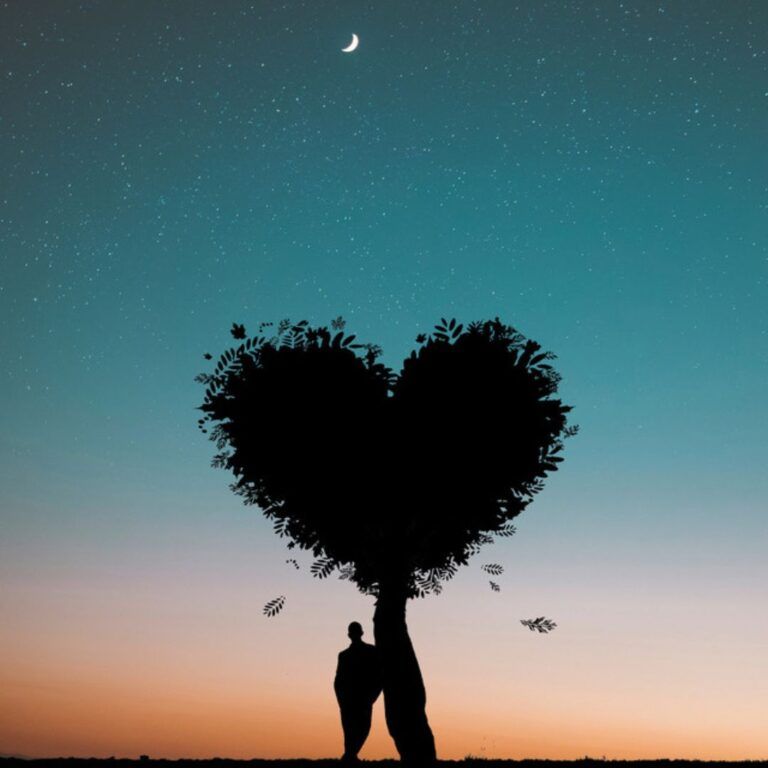
That night began like any other — soft wind, a faint hum in the air, and the moon caught halfway between silver and silence. The world didn’t know it was about to change. No one ever does, not really. People notice storms only after the first drop hits their skin.
In a small town that smelled of pine and rain, the power went out just after sunset. Every porch light blinked once and surrendered. Streetlamps dimmed. Windows became mirrors, showing people to themselves. For a while, no one panicked — just candles lit, old flashlights shaken, radios turned to static.
And then someone looked up.
At first, the stars seemed brighter. The kind of brightness that made you think the universe had turned the dimmer knob the wrong way. But then — someone gasped. Another pointed. A child on a porch dropped her toy.
Because the stars were moving.
Not falling, not like the meteor showers that everyone used to wish on — no, these stars were rising. Slow at first, like lanterns loosed from invisible strings, then faster, trembling in the dark as if the sky itself was letting go.
People came outside. Barefoot, confused, drawn as if by instinct. The air carried a strange, low sound — something between wind and a hum. The stars didn’t just glow; they pulsed, like they were breathing.
A woman on the street whispered, “They’re going home.”
No one knew what she meant, but no one contradicted her either.
Upward the stars went, in streams and spirals. The constellations broke apart, their patterns dissolving. Orion’s belt snapped. The North Star flickered, then shot higher, leaving behind a streak that burned for minutes before fading. It felt like watching a soul leave a body.
And everywhere — the darkness deepened.
The night didn’t look empty; it looked wounded.
Children cried. Old men took off their hats. Someone began to pray softly in a language most had forgotten. Phones captured videos that looked unreal, light bending and reversing like a film rewound.
But no one could explain why.
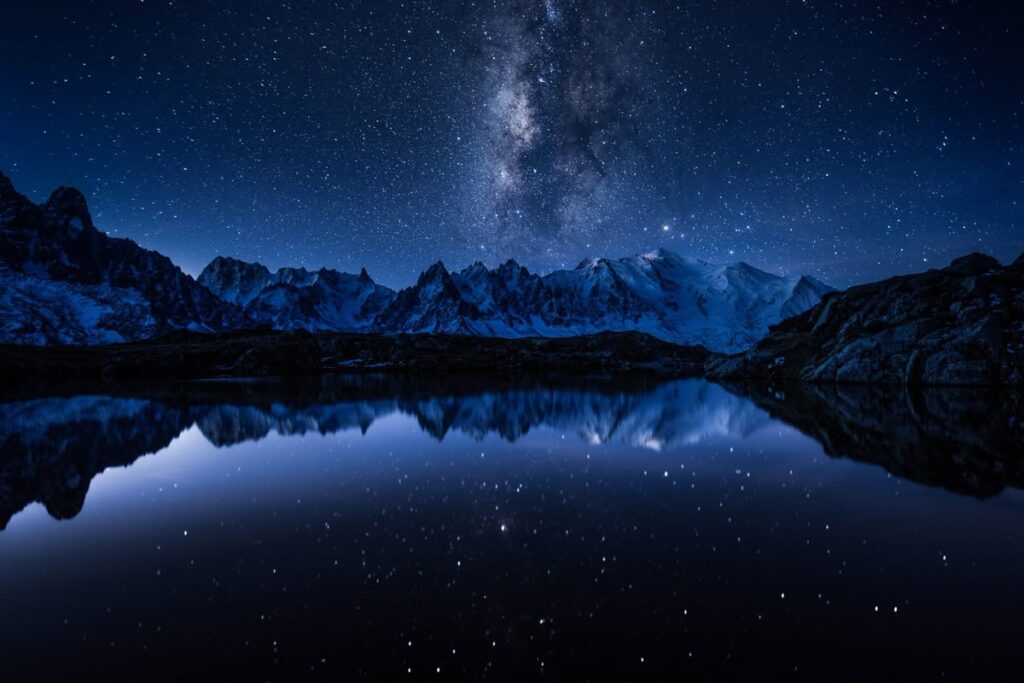
By midnight, the whole town had gathered by the lake — the same lake where kids swam in summer, where lovers carved initials into the railing, where old fishermen sat in quiet companionship. Now it was a mirror to the impossible — reflecting stars as they lifted themselves out of the sky.
The water shimmered not with what was above, but what was leaving.
One by one, the reflections vanished.
And with every star that rose, something else stirred in the air — faint shapes, outlines of things long unseen. A child pointed at the sky and said, “Look! Someone’s waving!” But there was no one there. Only shadows, like memories that had been waiting for the light to leave.
It was then that Mira noticed the figure on the far end of the dock.
She didn’t know his name. She had seen him before — the man who worked at the old gas station, who filled her car with quiet eyes and always said “safe travels” as if it were a prayer. Now he stood at the edge of the water, looking up, his face lit by a faint glow.
Something about him felt… still. Not peaceful, not tense. Just still.
When she walked closer, the boards creaked. He didn’t turn. The stars kept rising, faster now — a thousand tiny flames ascending into nothingness.
“What’s happening?” she asked.
His voice, when it came, was low. “They’re taking it back.”
“What?”
“The light,” he said. “Everything we borrowed.”
The way he said it made her shiver. She wanted to ask what he meant, but before she could, something broke the surface of the lake — a soft ripple that spread outward in perfect circles. For a moment, she thought it was just a fish, but then the ripples began to glow too, faintly golden, like threads being pulled upward from the water.
When she looked closer, she saw shapes in the glow — faces, outlines, hands reaching up. They weren’t clear, more like reflections trapped under glass.
“Do you see that?” she whispered.
He nodded. “Everyone’s got something the dark wants back.”
Behind them, the town was quiet. No traffic, no noise — only the sound of distant sobbing, the hush of wind through the trees. The stars had become streaks now, ribbons of light twisting higher, vanishing into the endless black.
Somewhere, a baby laughed — too bright, too loud. It echoed strangely, like the sound didn’t know where to go.
Mira’s heart thudded in her chest. “What happens when they’re gone?”
He looked at her finally, and his eyes caught the last of the starlight. “We see what’s left.”
It was a simple answer, but it felt like the kind of truth people spend lifetimes running from.
As the last few stars began to rise, the ground seemed to hum faintly beneath their feet. Not like an earthquake — more like a song, too low to hear but strong enough to feel. Trees swayed though there was no wind. The lake rippled again.
And then — silence.
The sky was black. Not midnight black, not indigo or blue. Pure, hollow, endless.
People waited, but nothing happened. The man on the dock exhaled slowly, almost with relief. Mira couldn’t move. The air was cold now, sharper somehow.
Then, just as the world seemed to pause — the first light returned.
But it wasn’t from above. It came from below.
All across the lake, the water began to shimmer — tiny points of light, rising from the depths like reversed rain. The glow was softer than the stars had been, but warmer, almost golden-white, like candlelight behind a curtain.
Mira gasped. “They’re coming back!”
The man shook his head. “Not the same ones.”
The lights rose out of the water, passed through the air, and settled — not in the sky, but among the people. They floated close to faces, hovered near hands, lingered where tears had fallen. Some landed on the roofs of houses, some on the empty swings in the park, some on the graves in the old cemetery at the hill’s edge.
Each light pulsed once, twice — then vanished.
And where they disappeared, something stayed.
For a second, Mira saw it clearly — the outline of her brother, gone two winters ago, standing at the end of the dock, smiling.
He didn’t speak. He didn’t need to.
The air shimmered, and he was gone, leaving only warmth behind.
She fell to her knees. Not out of fear, but from the weight of memory suddenly made real.
When she looked up again, the man was still there, still staring at the empty sky. His expression was unreadable.
“Who are you?” she asked quietly.
He smiled faintly. “Just someone waiting to see if she’ll wave back.”
And he pointed upward.
Mira followed his gaze. There, higher than the rest, a single star still lingered — trembling, slow to rise. It flickered once, as if hesitating.
Then it began to ascend.
The man raised his hand, and for the briefest instant, Mira saw a figure in the light — a woman’s shape, outlined in glow, reaching toward him.
“Goodnight,” he whispered.
And the star was gone.
The silence that followed was heavier than sound.
By dawn, the sky was still empty. The world was dim, as if morning had forgotten how to begin. Birds didn’t sing. The sun rose weakly, pale and washed-out, like it had lost something too.
News traveled fast — videos, recordings, theories. Some said it was magnetic fields, some said government tests, some said divine reckoning. But none of the explanations changed what people felt — that something vast and old had shifted.
For days, no stars returned. Nights were deep and blank. People began to miss the constellations not as lights, but as company.
Children drew them on ceilings with glow paint. Scientists wept on live television. Lovers who used to wish on stars stopped making wishes at all.
But in that same darkness, something else began to grow — the smallest, faintest specks, not in the sky, but in people’s eyes. When Mira looked at others, she noticed it — a faint shimmer behind their pupils, as if they were carrying fragments of the lost sky.
And maybe they were.
Because every time someone remembered someone they’d lost — a parent, a friend, a pet, a love — the air around them glowed just slightly.
Tiny sparks, invisible unless you truly looked.
Weeks later, Mira returned to the lake. The dock was the same, the water calm. The man was gone, but the quiet remained — a peaceful kind of silence, not emptiness. She sat there until the wind changed, carrying the scent of rain and pine again.
And when she looked at the water, she saw a reflection that wasn’t hers.
Her brother again — smiling, clear this time.
Only now, the stars behind him were rising still — upward, endlessly, like light learning to climb home.
She didn’t move. The reflection rippled once, and she thought if she breathed too loudly it might vanish. The water shimmered faintly around his outline — not cold, not ghostly, but warm like a lantern seen through glass.
“Mira,” she whispered to herself, just to hear something human in the stillness.
Her brother didn’t answer, but his mouth curved into that same half-smile he always had — the one that used to mean don’t worry, I’m fine. And then, before her eyes could blur from tears, the image dissolved into circles of light that floated upward, small as dust motes, disappearing into the dawn sky that still had no stars.
Mira didn’t cry. She only sat there until the world felt heavy again, until she realized she could hear her heartbeat.
When she finally stood, her legs trembled as though she’d been asleep for years. The boards creaked under her feet, and with every step toward shore, it felt like walking out of a dream — one that had wanted her to stay.
The town was quieter now, weeks after that night. The videos that had once gone viral faded into the noise of new headlines, new distractions. But something in people had changed.
They spoke softer. Looked at one another longer.
The baker across from Mira’s apartment had stopped playing the radio, but he left a candle burning on the counter every night. Children no longer feared the dark, because their parents told them, “That’s where the stars are resting.”
The empty sky became less a loss, more a promise.
But not everyone could live with the silence it left.
Some nights, Mira heard people drive to the hills and shout into the void, begging for the stars to return, for the light to come back. The echoes came back empty, but still they went — as if grief needed a place to echo from.
Mira didn’t go with them. She found her own ritual instead.
Each night, just after the last of the streetlights went out, she’d sit by her window, a single candle lit on the sill. She never prayed or wished — she just waited. Sometimes she’d catch faint sparks, like fireflies, drifting through the air. They always vanished before she could be sure.
She began to notice them more when she thought of people — her mother’s laughter, her brother’s voice, the man from the dock. Each memory left a glow, like something invisible nodding back.
One night, unable to sleep, she walked to the gas station where she’d last seen him. The place was closed — the door chained, the windows dusty. But behind the glass, on the counter, sat a small box.
Inside it was a folded piece of paper and a matchbook.
Her hands shook when she opened the note. It read, in careful handwriting:
“If you ever miss the light, remember — it’s not gone. It’s just learning your face.”
She pressed the note to her chest and looked up at the sky again. Still empty, still vast. But maybe not lonely.
Because in that deep black, she thought she saw something stir — faint threads, like veins of gold weaving through the dark, too far to touch but too alive to ignore.
They didn’t fall or rise. They simply waited.
As the years passed, the world learned to live without the stars.
Scientists built artificial constellations — satellites that glittered like the old patterns. Children grew up tracing them on screens, calling them “The Borrowed Sky.” Artists painted galaxies from memory. Astronomers became poets, writing about the silence beyond sight.
But in small towns, by lakes and forests, people told different stories.
They said that the stars had risen because the world had become too heavy, that light needed to leave before it drowned. Some said each star carried a soul — a fragment of all the forgotten things, rising back to where they belonged.
And a few believed the stars were waiting — not gone, but hiding until humans learned how to look upward without asking for something in return.
Mira liked that one best.
She aged quietly, her hair silvering like moonlight. The candle ritual remained, every night, without fail. Sometimes she spoke softly to the flame — telling it about her day, about the people who’d come and gone, about how the town had changed.
And some nights, when she blew it out, the smoke curled into shapes she almost recognized — a laugh, a hand, a glance from years ago.
It was on the fiftieth anniversary of the Night the Stars Fell Upward that something changed again.
People gathered by the same lake, now ringed with lanterns and benches. Children who hadn’t been born back then came with their grandparents, listening to old stories told around fires.
The town had made it a ritual — “The Night of Light.” They didn’t celebrate what was lost; they celebrated what remained. Candles floated on the water like little suns, their reflections dancing in dark waves.
Mira sat near the edge, her cane beside her, her face lit gold by hundreds of flames. She closed her eyes and listened to the laughter, the soft singing, the rustle of the wind.
Then — just as the first candle drifted too far to see — someone gasped.
She opened her eyes.
Above them, in the black sky that had been empty for half a century, something shimmered.
At first, it looked like smoke. Then, like thin threads of dust. But slowly, unmistakably, one by one, faint lights began to appear.
Not falling. Not rising.
Just glowing.
The crowd fell silent. Someone whispered, “It’s them.”
Mira’s heart thudded painfully, but she couldn’t look away. The stars — faint, smaller than before — flickered like timid eyes opening after a long sleep.
The constellations didn’t return the same way. They were scattered, freer, wild. But they were there.
And the lake, the same lake that had once reflected the stars leaving, now reflected their return. The ripples looked like time running backward.
Mira smiled through her tears. “Welcome back,” she whispered.
Then she noticed something else.
All across the crowd, tiny lights began to lift from people’s shoulders, their hands, their hair — glowing specks rising gently into the air, joining the faint stars above. Each one pulsed softly before merging with the sky.
And when she looked down at her hands, she saw it too — her skin glowing from within, the same way his had on the dock so many years ago.
She wasn’t afraid.
“Everyone’s got something the dark wants back,” he had said. Maybe this was the other half of that truth — that everyone also has something the light wants home.
The stars pulsed brighter. The air felt full of warmth, like every breath carried memory and forgiveness at once.
Mira looked up, eyes wet but shining. “Tell her she waved back,” she whispered to the night.
Then she closed her eyes.
Her candle went out — not with smoke, but with light.
And for a moment, it seemed the whole sky inhaled.
Every star burned a little brighter. Every ripple glowed a little longer.
And somewhere between the water and the dark, two figures met again — one rising, one waiting, both made of light going home.
When morning came, the world didn’t talk of miracles. Scientists said atmospheric refraction, a new phenomenon. The news called it “The Second Dawn.” But in that small town, no one cared for explanations.
They just knew the stars had forgiven them.
And from that day forward, people stopped wishing on the stars. They whispered thank you instead.
Want to read a bit more? Find some more of my writings here-
Human Rights Day — December 10
Peppermint Oil: Nature’s Little Miracle in a Bottle
Book Review: Harry Potter and the Cursed Child
I hope you liked the content.
To share your views, you can simply send me an email.
Thank you for being keen readers to a small-time writer.