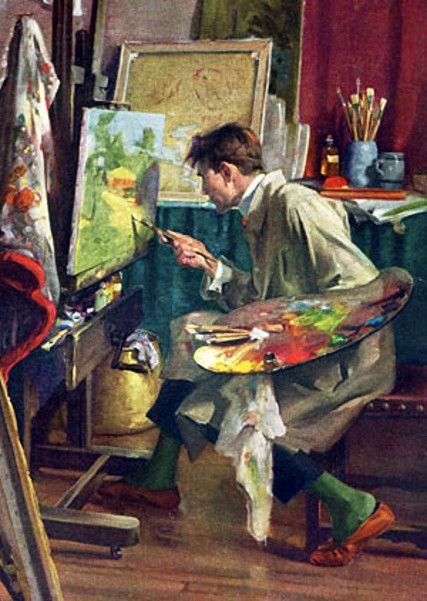
They said he painted emotions.
But Elias used to whisper to himself, “No, I paint silence.”
Silence was the only thing that stayed with him after the colors left.
He had once seen them — all of them. The way dawn melted into blue, the way the first green of spring made children run barefoot into the fields, the way crimson bled from the sun when it fell. But that was before the accident, before the glass shattered and scattered his world into shades he could no longer name.
He could still see shapes, light, and shadows. He could see people’s faces, but they looked drained — as if life had left them in grayscale. To Elias, the world now existed in whispers of gray, soft and cruel. Yet every morning, he picked up his brush, mixed his paints like he could still see them, and painted until his hands trembled.
And somehow, people wept when they saw his art.
He lived in a small town near the edge of the sea — a place where the fog lingered like an old friend. The locals called him “The Blind Painter” though he wasn’t truly blind. He could walk to the harbor without stumbling, find his way to the bakery by the smell of warm bread, and wave to the children who loved to peek through his studio window.
Inside that studio, the air was thick with the smell of turpentine, old brushes, and drying paint. The walls were covered in his works — hundreds of canvases layered on top of one another, leaning, curling, waiting. They were the color of grief and hope, of something unnamed.
Visitors would come in quietly, stand before a painting, and their throats would tighten. Some would cry without knowing why. Others would whisper, “It feels like it’s looking at me.”
When they asked him, “How do you do it without seeing?”, he would smile faintly and say,
“Maybe I’m not painting what’s seen. Maybe I’m painting what’s left behind.”
Every evening, he would sit by the window and listen to the sea crash against the cliffs. The horizon looked like an endless wound to him — dark, cold, uncolored. Yet, in his mind, he remembered. He remembered how the ocean once looked under sunset, when gold kissed every wave and turned it to fire.
Sometimes, he would try to paint it again from memory. But no matter how much he tried, the colors never felt right. So he stopped naming them altogether.
He began calling them by emotions instead.
That deep shade he used to paint the ocean — he called it Regret.
The softer tone he used for dawn — Forgiveness.
The bright strokes around people’s faces — Joy trying to return.
And slowly, his paintings began to tell stories no one else could see, yet everyone could feel.
One afternoon, a girl walked into his studio. She was around seventeen, with a freckled face and a notebook tucked under her arm. Her name was Lila.
She had been coming every day, standing outside the window to watch him work, but she never entered until that day.
Elias looked up from his canvas and smiled. “You finally decided to come in,” he said softly.
Lila blushed. “I didn’t want to disturb you. But I had to ask…” she hesitated, glancing at the half-finished painting. “What color is that?”
Elias’s hand froze on the brush. He smiled faintly. “What color do you see?”
She looked closer, squinting. “It’s… strange. It’s not blue, not green. It feels warm but not red. It’s like… something that doesn’t exist.”
He chuckled softly. “Then we see the same thing.”
Lila frowned. “But that’s impossible. You can’t see colors.”
Elias dipped his brush again, slowly dragging it across the canvas. “Maybe colors aren’t meant to be seen,” he murmured. “Maybe they’re meant to be felt.”
She stood silently, watching him paint with closed eyes, his fingers trembling but certain. When he finished the last stroke, he sighed deeply — the kind of sigh that sounded like letting go.
Then he said, “You know, when I lost my sight, I thought I’d never paint again. But now I think — I never really saw until I stopped looking.”
That evening, Lila walked home under the lilac sky — though to Elias, it was only fading light. She couldn’t stop thinking about his words. Maybe colors are meant to be felt.
She came again the next day. And the day after that.
She started bringing poems she wrote, inspired by his art. He would listen as she read them aloud — her voice soft and trembling. In return, he would tell her about the way colors once used to sound.
“Yes, sound,” he explained one morning when she asked. “Each color had its own hum. Red — like the low thrum of a cello. Blue — like a distant flute. Yellow was laughter. I can still hear them when I paint, faintly, as if from another room.”
Lila wrote that line down immediately.
And so began their strange friendship — the blind painter and the girl who translated his silence into words.
One winter night, a storm rolled in from the sea. The wind howled through the narrow streets, slamming against windows and doors. Lila rushed to his studio the next morning, worried he might not be alright.
She found him sitting by the window, brush in hand, staring at a blank canvas. His hands were shaking more than usual.
“I had a dream,” he said quietly. “I saw the color again. The one that doesn’t exist.”
Lila tilted her head. “What was it like?”
He smiled faintly. “Like warmth without heat. Like light without sight. It was the color of remembering something you never had.”
He began painting feverishly. The sound of the brush scratching against the canvas filled the small room. Lila didn’t speak — she just watched as his movements grew faster, more desperate, like a man chasing a ghost.
When he finally stopped, his face was wet with tears.
He whispered, “I think I found it.”
Lila turned toward the canvas — and she froze.
The color shimmered. It wasn’t any color she had ever seen. It wasn’t gold, or violet, or turquoise. It felt alive. It made her heart ache and her skin tingle.
For a moment, she forgot to breathe.
“It’s beautiful,” she whispered.
Elias smiled faintly, but there was something haunted in his expression. “Then I’ve done it. I’ve painted what’s not supposed to be seen.”
Word spread across the town like fire. People came from miles away to see the painting — The Color That Doesn’t Exist.
When they stood before it, silence fell. The gallery filled with people crying softly without understanding why. Some said it reminded them of childhood. Others said it felt like goodbye. But they all saw the same color — one they could never describe after they left.
News reached the cities. Critics came, journalists came, scientists came — and each one walked away confused and deeply moved. Cameras failed to capture the hue. When they tried to photograph it, the color turned gray. When they described it, their words contradicted one another.
It was as if the color refused to exist outside that room.
Elias grew quieter. He stopped painting for a while.
Lila, worried, asked him, “Does it frighten you?”
He nodded slowly. “Yes. Because I think the color wasn’t mine. It found me.”
Weeks passed. Winter began to melt into spring. But Elias looked older, frailer, like the painting had taken something from him. He would wake up at dawn, stare at the sea, and whisper to himself, “It’s fading.”
Lila begged him to rest, but he kept painting — more and more canvases filled with faint echoes of that impossible color. None were quite the same. Each one felt like a memory dissolving.
One evening, she found him slumped against his easel, eyes open but still. His breathing was shallow. She rushed to his side, clutching his hand.
“Elias,” she whispered. “Please stay. Please.”
He looked at her, eyes glassy but peaceful. “Do you see it?” he asked.
Tears streamed down her face. “Yes. I see it.”
He smiled softly. “Then I can go.”
And just like that, he was gone — his hand still stained with the color that doesn’t exist.
The townspeople buried him by the sea, where he had once watched the sunsets he could no longer see. Lila stood by his grave, clutching the notebook where she had written every word he ever said.
When she returned to his studio, the painting was gone.
All that remained was a faint mark on the wall — a shadow shaped like light. No one could explain it.
Years passed. Lila grew older, became a writer. She published a book called “The Color That Doesn’t Exist.” It told the story of a man who could no longer see the world but taught everyone else how to feel it.
People read it and cried.
Some swore that, while reading it, for a fleeting moment, they saw a glimmer of that color on the page — a warmth behind the words, something just beyond sight.
But late one evening, as Lila sat in her study, she saw something impossible.
On her wall — the shadow of a brushstroke. Soft. Luminous. The same hue she thought had vanished forever.
She stepped closer, her heart pounding. The air smelled faintly of paint and sea salt.
And then, from somewhere she couldn’t name, she heard his voice:
“Colors don’t die. They just move where eyes can’t follow.”
The light flickered, the color pulsed once more — and faded.
She stood there for a long time, tears slipping down her cheeks, whispering into the quiet room,
“I still see it, Elias. I still do.”

Want to read a bit more? Find some more of my writings here-
The Complete Guide to Vitamin B: The Unsung Hero of Energy, Mood, and Health
Festivus — The Holiday for the Rest of Us (Dec 23)
Book Review: Harry Potter and the Chamber of Secrets
I hope you liked the content.
To share your views, you can simply send me an email.
Thank you for being keen readers to a small-time writer.