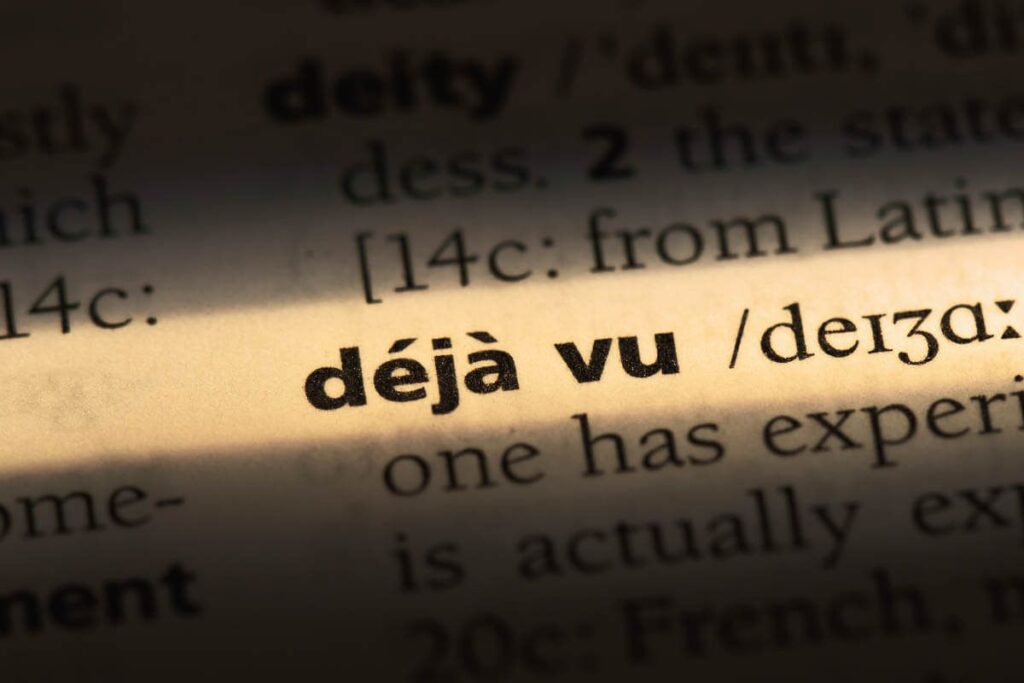
Have you ever walked into a new café, caught a whiff of roasted coffee beans, heard the hum of conversation — and suddenly felt like you’ve been there before? That fleeting, uncanny sensation where the present feels eerily familiar, as if life just pressed “replay,” is what we call déjà vu.
It’s one of the strangest and most fascinating experiences of human consciousness. For a few seconds, everything feels known, yet you know with absolute certainty it shouldn’t. You stand there, caught between memory and illusion, wondering: Have I lived this exact moment before?
Let’s dive into the psychology, science, and spirituality of déjà vu, exploring why it happens, what it says about our minds, and why this strange little glitch in reality continues to captivate us.
What Exactly Is Déjà Vu?
The term déjà vu comes from French, meaning “already seen.” Coined in the late 19th century by philosopher Émile Boirac, it describes the feeling that a current experience has already been lived — even though it’s objectively new.
It’s not just about seeing something familiar; it’s the conviction that this exact moment — every sight, sound, and thought — has unfolded before. Unlike a normal memory, déjà vu is unsettling because it blurs the boundary between what we know is new and what feels remembered.
Scientists estimate that about 60–80% of people experience déjà vu at least once in their lives. It’s more common among younger adults (typically 15–30 years old) and tends to occur during relaxed or slightly fatigued states — like when you’re daydreaming, traveling, or multitasking.
What Happens in the Brain During Déjà Vu?
Despite being so common, déjà vu remains one of the most mysterious phenomena in neuroscience. Scientists have been trying to decode it for decades, and the more we learn, the more complex it becomes.
1. The Memory Glitch Theory
One of the leading explanations is that déjà vu is a memory-processing error — a misfire between the short-term and long-term memory systems.
Normally, when you encounter something new, your brain’s hippocampus and temporal lobes assess and store information. However, during déjà vu, the brain mistakenly flags the current situation as a memory instead of a new experience.
In simpler terms, it’s like your brain accidentally labels a fresh moment as “seen before.”
Some researchers compare it to a computer lag — your brain momentarily duplicates a signal, creating a false sense of familiarity.
2. Dual Processing and “Neural Delay”
Another theory suggests that déjà vu happens when two cognitive processes — sensory perception and memory recognition — briefly fall out of sync.
Imagine walking into a room: your left eye processes the scene a split second before the right, but the brain stitches both images together. If there’s a tiny lag, your brain might interpret the second input as a repeat of the first — hence, déjà vu.
This neural delay theory explains why déjà vu often feels like a glitch in time: it’s the brain trying to sync itself back into the present.
3. The Familiarity Without Recall Hypothesis
Neuroscientist Anne Cleary proposed that déjà vu occurs when a new situation resembles something in memory — but the source of that familiarity remains hidden.
For instance, you might enter a new bookstore that happens to have the same layout, lighting, or scent as one you visited years ago. Your brain recognizes these subtle similarities but can’t pinpoint the source, leaving you with that eerie, “I’ve been here before” sensation.
In short: your memory is whispering, “This reminds me of something,” but your consciousness can’t locate the file.
Déjà Vu and the Brain’s Electrical Activity
Interestingly, déjà vu has a strong link to temporal lobe activity, particularly in people with temporal lobe epilepsy. Before a seizure, many patients report a vivid sense of déjà vu — as if the brain’s memory circuits are over-firing.
This connection has given researchers valuable clues:
- Electrical overstimulation in the hippocampus and entorhinal cortex can trigger false memory sensations.
- Even healthy individuals may experience microbursts of such activity without any seizure disorder — leading to ordinary déjà vu.
So, in essence, déjà vu might be the brain’s harmless version of a “mini electrical echo” — a flicker of overexcited neurons misinterpreting the present as the past.
The Psychology Behind Déjà Vu
While neuroscience offers fascinating insights, psychology gives us a more human lens. Why do our minds play these tricks — and what emotional or cognitive states make us prone to déjà vu?
1. When the Brain Tries to Predict
Your brain is a master predictor. It constantly anticipates the future based on past experiences. When something aligns too well with those expectations, it can create a strange overlap between “now” and “then.”
This predictive coding model suggests déjà vu is a side effect of the brain’s attempt to forecast reality — a moment where its prediction feels like memory.
2. The Stress and Fatigue Factor
Déjà vu tends to strike when you’re tired, distracted, or stressed — moments when your cognitive defenses are down.
Your brain, juggling too many signals, may crosswire information, leading to a brief confusion between memory and perception.
It’s why many people say, “I get déjà vu when I’m exhausted or zoning out.”
You’re not imagining it — your brain’s efficiency dips slightly, making misfires more likely.
3. Emotional Triggers
Certain emotions, especially nostalgia, melancholy, or awe, can heighten déjà vu experiences.
When you feel emotionally open or reflective, your brain’s associative networks become more active, allowing faint connections between unrelated memories to surface.
That’s why déjà vu often feels poetic — like a memory floating up from the depths of your subconscious, reminding you of something you can’t name.
Is Déjà Vu a Sign of Something Deeper?
Now and then, people wonder: does déjà vu mean something spiritual or psychic? Could it be a glimpse of a past life, an alternate timeline, or even a sign from the universe?
1. The Spiritual and Metaphysical Interpretations
Across cultures, déjà vu has been seen as more than just a brain glitch:
- Eastern philosophy sometimes links it to reincarnation — a faint echo of past lives.
- Mystics view it as soul recognition, suggesting that certain moments or people feel familiar because your spirit “remembers” them.
- New Age thought often ties déjà vu to parallel realities — brief alignments between alternate versions of yourself.
While science doesn’t support these explanations, they speak to our innate desire to find meaning in mystery. The human heart, after all, seeks poetry in the unknown.
2. Déjà Vu and Intuition
Some psychologists propose that déjà vu reflects an unconscious recognition — a gut-level awareness that you’ve encountered similar patterns before.
Your conscious mind can’t recall it, but your intuition can.
So, rather than being mystical, déjà vu might be your intuition whispering: “Pay attention — you’ve walked this path before in some way.”
The Opposite of Déjà Vu: Jamais Vu and Beyond
If déjà vu is the feeling that something new feels familiar, its eerie twin, jamais vu, is the reverse — when something familiar suddenly feels unfamiliar.
Imagine looking at your best friend’s face or reading a common word like “door” until it starts to look strange and foreign. That unsettling sense of alienation is jamais vu, and it shows how delicate our perception of familiarity really is.
Other related experiences include:
- Presque vu – the “tip of the tongue” feeling, when you’re about to recall something but can’t.
- Déjà vécu – the feeling that you’ve lived through an event before in full detail.
- Déjà senti – the sense of having felt the same emotion before.
Together, these remind us how intricate and fallible our memory and consciousness truly are.
Can Déjà Vu Be Controlled or Induced?
You can’t force déjà vu, but research shows it can sometimes be artificially triggered under experimental conditions.
In lab settings, researchers have used virtual reality and electrical brain stimulation to recreate déjà vu-like sensations. By presenting similar environments or subtly altered images, they trick the brain’s recognition system into feeling familiarity.
Interestingly, people who read fiction or play immersive video games report more déjà vu experiences. Why? Because these activities build rich, overlapping memory landscapes — giving the brain more “false alarms” to work with.
So, next time you’re lost in a vivid movie or a book from Riya’s Blogs that feels oddly familiar, you might just be experiencing the softer side of déjà vu.
When Déjà Vu Becomes Persistent
Though usually harmless, frequent or intense déjà vu can sometimes be associated with neurological conditions:
- Temporal lobe epilepsy (as discussed earlier)
- Anxiety or dissociative disorders
- Certain medications or sleep deprivation
If déjà vu happens repeatedly — several times a week, for example — or comes with confusion or memory gaps, it’s wise to discuss it with a doctor or neurologist.
For most people, though, déjà vu is perfectly normal — just another sign that the brain is wonderfully complex and sometimes a little bit whimsical.
Why Déjà Vu Feels So Poetic
Part of what makes déjà vu so enchanting is its aesthetic quality. It’s like life whispering, “Pay attention — this moment matters.”
For a second, the world slows down. You feel both inside and outside of time, like a spectator in your own story.
Writers, poets, and filmmakers often use déjà vu as a motif to explore fate, memory, and destiny. From The Matrix to literary works by Proust and Murakami, déjà vu becomes a metaphor for the blur between dream and reality.
On a personal level, it can be grounding — a reminder that life is cyclical, interconnected, and rich with echoes we may never fully understand.
The Science Still Unfolds
Even in 2025, scientists continue to explore déjà vu through neuroimaging, AI-assisted pattern recognition, and cognitive modeling. Each discovery adds another piece to the puzzle — but the full picture remains elusive.
Maybe that’s the beauty of it.
Déjà vu stands at the crossroads of science and mystery — a moment where the rational mind meets the poetic soul.
It reminds us that not everything needs to be fully explained to be meaningful.
Final Thoughts: Embrace the Mystery
Next time déjà vu washes over you, don’t rush to shake it off.
Pause.
Let yourself feel that strange familiarity — as if your soul is whispering through the folds of time. Maybe it’s your brain glitching, maybe it’s memory misfiring, or maybe — just maybe — it’s something more profound.
Whatever it is, déjà vu remains one of life’s most beautiful mysteries — a fleeting reminder that the mind is deeper, and the universe more interconnected, than we can ever fully grasp.
And as Riya’s Blogs often celebrates — sometimes, it’s okay to simply live the question, not chase the answer.
Want to read a bit more? Find some more of my writings here-
Book Review: Reveal Me by Tahereh Mafi
The Postman Who Delivers to Heaven: A Heartfelt Short Story
National Peculiar People Day Messages — January 10
I hope you liked the content.
To share your views, you can simply send me an email.
Thank you for being keen readers to a small-time writer.