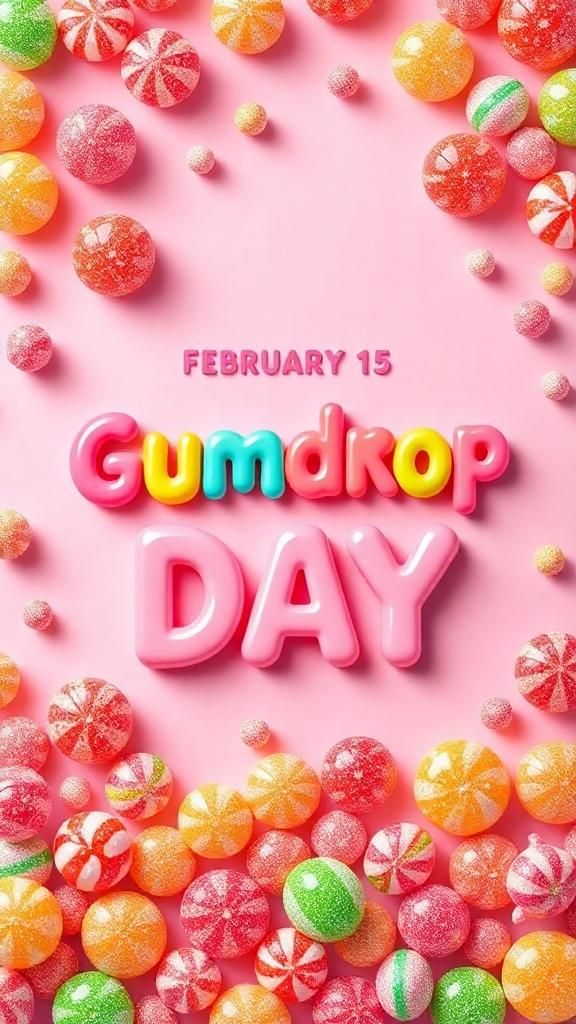
If you love old-school treats, February 15 has a tiny, colorful reason to smile: National Gumdrop Day (often shortened in searches to Gumdrop Day). It’s one of those fun, low-pressure “candy holiday” moments that doesn’t ask much of you—just an excuse to enjoy a chewy handful of jelly sweets, remember the candy aisle from childhood, and appreciate how small sugar treats can carry big nostalgia.
This day isn’t about complicated traditions or formal ceremonies. It’s about a classic candy that’s been around for generations, still showing up in jars on counters, holiday baking projects, and movie-night snack bowls. And if you’ve ever wondered what gumdrops actually are, where they came from, or whether they’re still popular, you’re not alone—those are some of the most common User Search Queries around Gumdrop Day, and we’ll cover them in a simple, practical way.
What are gumdrops?
Gumdrops are small, chewy candies—usually rounded or dome-shaped—most often coated in granulated sugar so they don’t stick together. That sugar coating also gives them their signature look: sparkly, bright, and slightly crunchy on the outside.
At their core, gumdrops belong to a wider family of confectionery known as jelly or gel candies. Depending on the brand and recipe, their chewy texture typically comes from one of these setting agents:
- Gelatin (common in many traditional gumdrops)
- Pectin (often used in fruit jellies and some plant-based candies)
- Starch-based gels (another classic technique in candy-making)
Flavor-wise, gumdrops are usually fruit-inspired—think cherry, orange, lemon, lime, grape—but you’ll also find spice varieties (like cinnamon and clove), minty options, and seasonal mixes.
So why are they called “gumdrops”? The name likely comes from the candy’s “gummy” chew and drop-like shape. Some older confectionery traditions used ingredients like gum arabic (a natural plant gum) in chewy sweets, and that may have influenced naming in early candy culture. What matters most today is the experience: gumdrops are meant to be pleasantly chewy, not hard like rock candy and not as soft as gummy bears.
If you’re comparing them to other jelly sweets, here’s a quick mental map:
- Gumdrops: chewy, sugar-coated, often dome-shaped
- Jelly beans: crisp shell outside, soft chewy inside
- Jujubes: firmer, denser chew, usually glossy without sugar coating
- Fruit jellies/Turkish delight: softer, often dusted with powdered sugar or starch
Gumdrops sit right in the middle: chewy enough to feel satisfying, soft enough to snack on easily, and sweet enough to qualify as a classic sugar treat.
Why celebrate Gumdrop Day?
Honestly? Because it’s fun—and because it taps into something bigger than candy.
Gumdrop Day is a “small joy” holiday. It’s a quick reminder that food culture isn’t only about fancy dishes and gourmet trends. Sometimes it’s about a simple treat that’s been passed through generations, sitting quietly in the background of everyday life.
Here’s why this candy holiday works so well:
- It’s nostalgic without being complicated.
Gumdrops remind many people of childhood candy jars, grandma’s kitchen, or holiday baking. That “nostalgic candy” feeling is powerful—and it’s nice to have a day that leans into it. - It’s easy to celebrate in your own way.
You can eat a few gumdrops, bake with them, share them, or even just learn about their past. No pressure. - It highlights a real piece of confectionery history.
Gumdrops are part of a long tradition of chewy sweets made possible by sugar refining, gelatin/pectin use, and candy-making techniques that evolved over the last couple of centuries.
And if you’re celebrating right after Valentine’s Day, February 15 is also a clever little “sweet encore.” Valentine’s often means chocolate and romance; February 15 can be playful, casual, and colorful.
At Riya’s Blogs, we love celebrations like this because they remind us that joy can be simple—and sometimes it’s literally sitting in a candy bowl.
Where did gumdrops originate?
This is one of the most searched questions: “Where did gumdrops originate?” The honest answer is that gumdrops don’t have one universally agreed-upon “single inventor” story that’s easy to prove in a neat line. But we can talk about the most reasonable, widely accepted context from confectionery history.
The big picture: gumdrops grew out of jelly candy traditions
Long before modern packaged candy, many cultures made gel-like sweets using fruit concentrates, honey, plant gums, and later refined sugar. Over time, candy-making became more standardized—especially as sugar became more accessible and industrial food production expanded.
By the 19th century and early 20th century, confectioners in the United States and Europe were producing a growing variety of chewy candies. Gumdrops fit perfectly into that era: small, consistent shapes, easy to portion, easy to sell by weight, and stable enough to store.
The technique behind the candy
A key part of gumdrop-style candy is molding. A classic method uses starch molding, where impressions are made in starch trays and a hot candy mixture is poured in to set. This method supports smooth, consistent shapes and works well for jelly-type candies. That kind of technique helped chewy candies scale up from local confectioners to wider commercial production.
Why origin stories get fuzzy
Candy origin stories often become “fuzzy” for a simple reason: many sweets evolved gradually. One confectioner might popularize a style, another might brand and distribute it widely, and another might industrialize it. Gumdrops likely spread the same way—more like a trend that became a staple than a single lightning-bolt invention.
So, if you want a clean takeaway: gumdrops are a classic American-style jelly candy that became popular as commercial confectionery expanded in the late 1800s and early 1900s, using evolving techniques that made chewy sweets more consistent and widely available.
That’s the heart of the confectionery history behind gumdrops—and it’s also why they feel so “timeless.” They’re tied to a period when candy became a familiar, everyday treat rather than an occasional luxury.
How is Gumdrop Day celebrated?
Another top query is “How is it celebrated?” The best part is that Gumdrop Day is flexible. Here are simple, realistic ways people celebrate the February 15 event without turning it into a big production:
1) Eat them the classic way
Sometimes the best celebration is the most obvious one: buy a small bag or mix, pour a handful into a bowl, and snack. Try a flavor you don’t usually pick—spice gumdrops can feel totally different from fruit ones.
2) Create a mini “gumdrop tasting”
If you want something slightly more fun (but still easy), do a quick tasting:
- Line up a few flavors
- Notice the differences in chew (some are softer, some firmer)
- See which ones have stronger citrus notes, which taste more artificial, and which feel more “old-fashioned”
It sounds silly, but it’s a great way to make a small candy holiday feel intentional.
3) Bake or decorate with gumdrops
Gumdrops have a long life in home baking and decorating because they’re colorful and hold their shape. Popular uses include:
- Holiday cookies and decorative toppings
- Gingerbread houses (gumdrops make perfect “windows” and “buttons”)
- Cake or cupcake decoration (especially for kids’ parties)
- Chopped into bits and mixed into certain dessert bars
If you want a simple idea: slice gumdrops in half and press them into cookie dough before baking. It looks festive with almost no effort.
4) Share a candy jar moment
Gumdrops are made for sharing. Put a small jar on your desk, offer a few to friends or coworkers, or make a tiny “treat bag” for someone. It’s a sweet gesture that costs very little but feels warm and old-school.
5) Pair it with a “nostalgia night”
Because gumdrops are a nostalgic candy, they pair well with nostalgic activities:
- Watch a comfort movie from childhood
- Play an old playlist
- Look through old photos
- Make a cozy night of it and let gumdrops be part of the vibe
Gumdrop Day doesn’t need more than that.
Are gumdrops still popular?
This is a fair question, because gumdrops don’t always get the spotlight like sour gummies or trendy imported candies. But yes—gumdrops are still popular, just in a quieter way.
They’ve shifted from “top candy craze” to “steady classic.” You’ll still see them because they serve a few roles extremely well:
- They’re shelf-stable and easy to store compared to chocolate-based candy.
- They’re visually appealing—bright, cheerful, and instantly recognizable.
- They’re versatile as both a snack and a decoration candy.
- They carry nostalgia, and nostalgia never really goes out of style.
Also, gumdrops have adapted. Today, you’ll find variations with different textures, flavor intensity, and sometimes ingredient changes (like pectin-based options) depending on the brand.
So while gumdrops may not dominate social media candy trends, they remain a familiar, loved part of everyday food culture—especially for people who enjoy classic sweets and old-fashioned candy shops.
A small note on ingredients and enjoying gumdrops mindfully
Because gumdrops are sugar treats, it’s worth saying gently: they’re best enjoyed as a treat, not a habit. They’re candy—meant for joy, not nutrition. If you’re mindful about ingredients, it can help to check labels, especially if you prefer:
- gelatin-free options
- specific flavoring types
- allergy-friendly facilities
But for most people, Gumdrop Day is just a fun, simple moment to enjoy a sweet bite and move on with your day feeling a little lighter.
Conclusion
National Gumdrop Day on February 15 is the kind of candy holiday that doesn’t demand anything dramatic—just a little appreciation for a bright, chewy classic that’s been part of confectionery history for generations. Whether you celebrate by snacking on a few fruity pieces, using gumdrops in baking, sharing a jar with someone, or simply learning the story behind this nostalgic candy, Gumdrop Day is a reminder that food culture is built as much on small traditions as it is on big events.
Gumdrops may be simple, but that’s their charm. They’re cheerful, familiar, and timeless—proof that sometimes the sweetest celebrations are the ones that fit in the palm of your hand.
Want to read a bit more? Find some more of my writings here-
February 15 – National Flag of Canada Day
Valentine’s Day (February 14): History, Traditions, and How Love Became a Global Celebration
February 14 – Valentine’s Day: Meaning, History, and How the World Celebrates Love
I hope you liked the content.
To share your views, you can simply send me an email.
Thank you for being keen readers to a small-time writer.