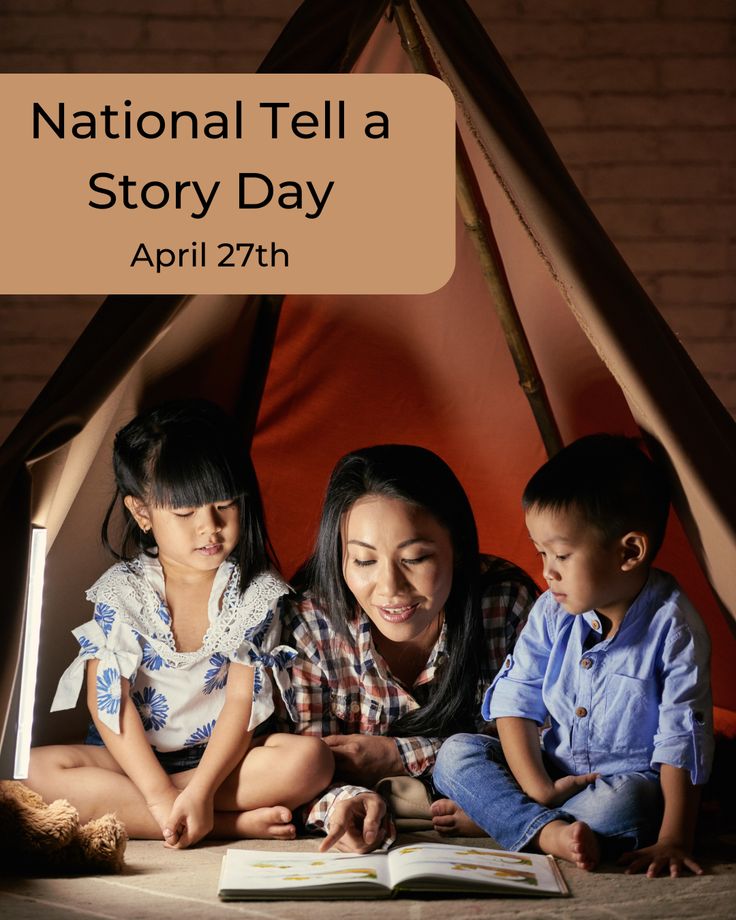
Tell a Story Day, observed on April 27, is one of those warm, low-pressure occasions that doesn’t demand decorations, spending, or a perfect plan. It simply invites you to do something deeply human: share a story. A tiny childhood memory, a hilarious office moment, a lesson you learned the hard way, a story your grandparents repeat every summer—anything counts. The point is not to be dramatic or “writer-level” brilliant. The point is to connect.
In a world full of short attention spans and scrolling, storytelling slows us down in the best way. It asks us to notice details: What did it smell like? What did you feel? What changed after that moment? That’s why Tell a Story Day works for everyone—students, families, creators, teachers, and even teams at work. And if you’re looking for what to post, fun team activity ideas, or short storytelling caption options, you’ll find plenty here.
What Tell a Story Day is really about
At its core, Tell a Story Day is an informal celebration of storytelling—spoken, written, acted out, recorded, illustrated, or even shared through a simple social media post. It’s less about a “history lesson holiday” and more about an experience-based day: a reminder that stories are how we make sense of life.
Think about it:
- We share stories to teach (life lessons, cultural values, “don’t do what I did” warnings).
- We share stories to bond (friendship, family, teamwork, empathy).
- We share stories to heal (processing grief, change, heartbreak, and growth).
- We share stories to laugh (chaos, coincidence, and the comedy of being human).
- We share stories to imagine (fiction, fantasy, “what if…”, creative play).
So whether you’re posting online, writing something private, or running an activity at school or work, Tell a Story Day is basically a permission slip to say:
“Let me tell you something that happened…”
Why storytelling still matters (even if you think you’re “not a storyteller”)
Many people believe storytelling is only for writers, speakers, or performers. But storytelling is already part of your daily life. You do it when you:
- explain how your day went,
- describe a trip,
- talk about a mistake and what you learned,
- share a family tradition,
- recall a funny moment,
- recommend a movie or book (“the plot is…”).
The difference between a “regular” conversation and a memorable story is usually just structure and detail—and you don’t need fancy skills to do that. A good story often has:
- A moment: something happened (big or small).
- A feeling: you felt something (confused, excited, embarrassed, proud).
- A change: you learned something, or something shifted afterward.
That’s it. Three simple ingredients.
And on Tell a Story Day, even a 4-line micro-story counts.
What to post on Tell a Story Day (easy ideas that feel personal)
If your first thought is “What do I even post?”, choose one of these simple formats:
1) A mini memory (3–6 lines)
- “I still remember the day I learned to ride a bicycle. I fell. I cried. Then my dad ran beside me until I stopped shaking. Today I realize it wasn’t about the cycle—it was about someone staying.”
2) A ‘then vs now’ story
- “Then: I used to panic before presentations. Now: I still panic, but I’ve learned that nerves mean I care. The first time I didn’t freeze was the day I told myself: ‘Just tell a story, not a speech.’”
3) A funny moment
- “The day I tried to sound professional in an email and accidentally typed ‘Kindly do the needful… for the pizza.’ My manager replied: ‘Approved.’”
4) A lesson learned
- “I once missed an opportunity because I waited to be ‘ready.’ Tell a Story Day reminder: start messy, learn loudly, and keep going.”
5) A story prompt post
- “Tell a Story Day: Drop a one-line plot twist in the comments. I’ll turn my favorite into a short story!”
These can be paired with tell a story day messages like:
- “Today’s reminder: your memories matter. Happy Tell a Story Day!”
- “On Tell a Story Day, share a moment that shaped you.”
- “A story doesn’t have to be long to be powerful.”
Tell a Story Day messages (ready-to-use, warm and shareable)
Here are tell a story day messages you can use for friends, family, classrooms, or social posts—kept simple and natural:
- “Happy Tell a Story Day! Share a memory that makes you smile every time.”
- “Tell a Story Day reminder: your voice is worth hearing.”
- “Today, let’s trade stories instead of scrolling—one real moment at a time.”
- “A good story can make someone feel less alone. Tell yours today.”
- “Happy Tell a Story Day! Funny, messy, heartfelt—your story belongs.”
- “Your life is made of moments. Pick one and tell it beautifully.”
- “Tell a Story Day: say the thing you’ve been meaning to share.”
- “Stories are bridges. Thanks for meeting me on the other side.”
- “If you don’t know what to say today, start with: ‘I still remember the day…’”
- “One story can spark courage in someone else. Tell it.”
Short storytelling captions and funny story captions (social-media friendly)
If you want short lines (especially for reels, photos, or stories), here are options that fit the vibe of Tell a Story Day:
Short storytelling captions
- “Here’s my little story.”
- “A moment I’ll never forget.”
- “Plot twist: I survived.”
- “True story. No edits.”
- “Once upon a Tuesday…”
- “This is how it started.”
- “And that’s why I laugh now.”
- “A memory worth keeping.”
- “Small moment. Big feeling.”
- “My life, one scene at a time.”
Funny story captions
- “I was confident for no reason.”
- “A professional mistake… with personality.”
- “Character development happened against my will.”
- “I learned nothing, but it was funny.”
- “I’ve made worse decisions. Just saying.”
- “If embarrassment paid rent, I’d own a house.”
- “This story has zero wisdom, only chaos.”
- “I thought I understood… I did not.”
- “Me: calm. Life: plot twist.”
- “Rated E for Everyone (except my ego).”
Storytelling quotes (useful for posts, posters, and intros)
Instead of using overly complicated quotes, here are clean, meaningful storytelling quotes you can use (and they work well for school or office settings too):
- “Stories turn moments into meaning.”
- “A story is a memory with a heartbeat.”
- “Tell the story only you can tell.”
- “Facts inform, but stories stay.”
- “A good story doesn’t need perfection—just truth.”
- “Every person you meet is carrying a chapter you haven’t read yet.”
- “Sometimes the bravest thing is telling the story out loud.”
- “When we share stories, we share survival.”
- “The smallest stories often hold the biggest feelings.”
- “Connection begins with: ‘Let me tell you something…’”
Creative writing prompts (quick prompts for beginners too)
If you want to celebrate with writing (even for 10 minutes), try these creative writing prompts. They’re designed to be easy, not intimidating:
- Write a story that begins with: “I wasn’t supposed to open it.”
- A character finds a note in a pocket they don’t own.
- Write about a smell that instantly brings back a memory.
- Two strangers keep meeting in different places—by coincidence… or not?
- A funny story about the day everything went wrong—but ended well.
- Write a micro-story in exactly 6 sentences.
- “The last time I felt brave was when…” (non-fiction or fiction)
- A message arrives that says: “Don’t trust the version of me you met yesterday.”
- Write from the perspective of an object on your desk (yes, seriously).
- A story where the “villain” is actually misunderstood.
If you’re posting, you can combine a prompt with a call-to-action:
“Tell a Story Day: choose prompt #3 and share what you write!”
Office storytelling challenge (team-friendly, simple, and not awkward)
If you’re searching for fun team activity ideas, an office storytelling challenge is one of the easiest ways to make Tell a Story Day feel special without forcing anyone to be extra. The key is to keep it short, optional, and safe (no pressure, no oversharing).
Here’s a clean format you can run in 20–30 minutes:
Step 1: Pick a theme (choose one)
- “My funniest work moment”
- “A small win I’m proud of”
- “A lesson I learned the hard way”
- “A customer story that stayed with me”
- “The best advice I ever received”
Step 2: Add a simple rule
- Each person gets 60–90 seconds, max.
- No slides. No performance. Just a story.
Step 3: Provide a storytelling template
To make it easy for everyone, give this structure:
- Set the scene: When/where was this?
- The moment: What happened?
- The takeaway: What did you learn / how did it change you?
Step 4: Add a fun twist (optional but office-safe)
- Vote for “Most Relatable,” “Funniest Plot Twist,” “Best Life Lesson”
- Or do a “Two Truths and a Story” round: two facts + one short story.
Step 5: Close with appreciation
End with a simple message:
“Thanks for sharing—today we didn’t just work together, we understood each other better.”
This kind of activity is especially good for remote teams too. People can share in chat, voice note, or during a quick stand-up.
A simple way to celebrate at home (family, friends, or solo)
If you want a quiet Tell a Story Day:
- Ask a parent/grandparent: “What’s a story from when you were my age?”
- Record a voice note telling a childhood memory.
- Start a “family stories” doc and add one story today.
- Re-watch a favorite movie and write a short “what I learned from it” story.
- Share a bedtime story with a younger sibling or child—then ask them to invent the ending.
Even 10 minutes is enough to make the day feel meaningful.
Conclusion
Tell a Story Day (April 27) isn’t about being the loudest voice in the room or writing a perfect masterpiece. It’s about remembering that stories are how we connect—how we laugh, learn, heal, and feel seen. Whether you share tell a story day messages, post funny story captions, use storytelling quotes, try creative writing prompts, or host an office storytelling challenge, you’re participating in something timeless: turning ordinary moments into meaning.
So if you’re not sure where to start, here’s your simplest first line:
“I still remember the day…”
And then just tell it.
Want to read a bit more? Find some more of my writings here-
ANZAC Day (April 25): Honoring Courage, Sacrifice, and Remembrance
World Meningitis Day (Apr 24): Respectful Messages, Awareness, and the Importance of Education
World Intellectual Property Day (April 26): Why Ideas Matter, and How We Protect Them
I hope you liked the content.
To share your views, you can simply send me an email.
Thank you for being keen readers to a small-time writer.