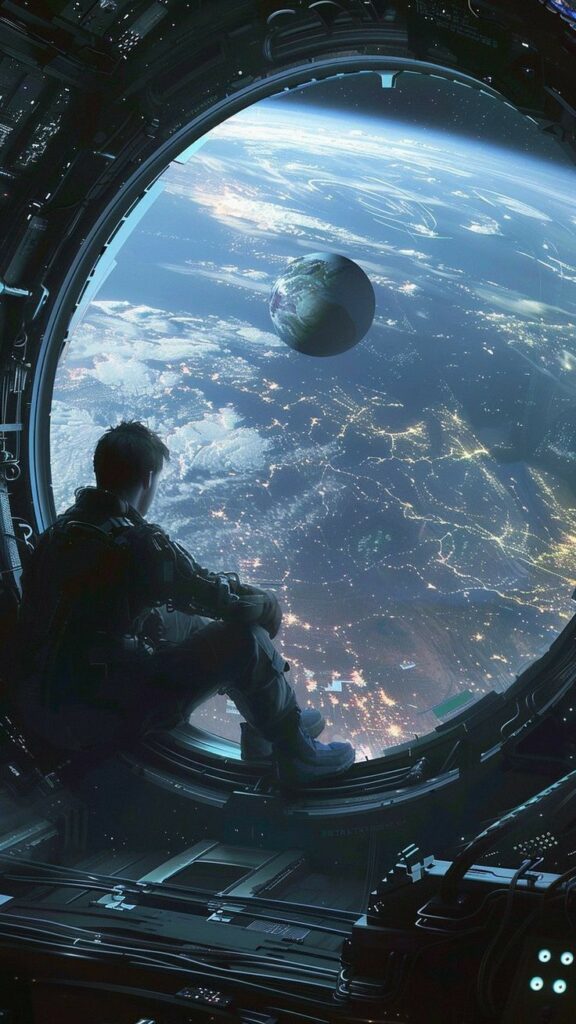
When Commander Elias Ward returned to Earth, he did not remember the stars.
He remembered rain.
Soft, endless rain falling on copper fields that shimmered under two suns. The air there had tasted faintly of iron and lilac. And when he closed his eyes that first night back on Earth—strapped into the quarantine cot at Johnson Space Center—he swore he could still hear the sound of tall grass bending under a storm he had never seen.
NASA thought it was the drugs at first. Re-entry trauma. Oxygen deprivation. The human mind cracking under cosmic silence. But Elias was calm, coherent, too precise for madness. He spoke of things no man could have imagined—cities carved into cliffs of glass, rivers that flowed backward, and a sky that pulsed like the heart of a dying god.
He swore he had walked there. Lived there.
And someone—something—had walked with him.
They found nothing wrong with him, at least nothing they could measure. Blood pressure normal. Reflexes intact. Neural scans showed patterns no one could read—half the cortex overactive, the other half eerily quiet. His dreams, recorded during observation, produced signals so complex they appeared almost encrypted.
Dr. Keira Lang, his assigned cognitive specialist, had seen many post-mission breakdowns. But this was different. Elias didn’t forget who he was—he remembered too much.
“I remember my childhood in Kansas,” he said, his voice low, eyes unfocused. “But I also remember standing under a violet sky where shadows move before light touches them. I remember names—words that sound human but aren’t. I can feel them. I can taste their syllables.”
“What names?” she asked.
He hesitated, then whispered one.
The sound felt wrong in the room. The lights flickered—just once—but enough for Keira to glance at the ceiling.
Later, when she checked the audio file, the word was gone.
Only static.
NASA never publicly acknowledged that the Odyssey III mission failed. The shuttle had gone dark for seven minutes before re-entry, its comms silent, its data feed cut. When it reappeared, everything inside was as it should be—except for one missing crewmate.
Dr. Jonah Ruiz had been seated right next to Elias. His harness was still fastened. His suit was intact. But the seat was empty.
“Vaporized,” the engineers said. “Maybe a depressurization event.”
But Elias’s report was different.
“He stepped out,” he told Keira one evening, when the sedatives had softened his defenses. “He stepped out through the air itself. It opened like a curtain. He looked at me and said, ‘It’s remembering now.’ Then he was gone.”
She waited, pulse steady. “What was remembering?”
“The planet.”
In the weeks that followed, Elias began to draw. He filled pages with looping symbols, geometries that hurt the eyes if you stared too long. Circles nested inside shapes that folded in on themselves—like the blueprints of thoughts not meant for human minds.
When they asked what they meant, he said quietly, “It’s what it showed me.”
“What it?”
“The world beneath the one we see. The world that remembers everything we forget.”
He started keeping a journal then. The handwriting grew stranger each day—letters dissolving into curves, words rearranging themselves mid-sentence. Some nights, cameras caught him standing motionless for hours, head tilted, as if listening to something far away.
In one recording, he finally spoke.
“They’re not dead,” he murmured. “They’re dreaming through us.”
On the 40th day of observation, he vanished.
No alarms. No broken locks. Just an empty cot and the faint smell of ozone in the air.
Security footage showed him walking down the hall in his white hospital scrubs. He turned the corner near Lab 3B—and didn’t appear on the next camera. The feed blinked, as though a frame had been cut.
NASA locked down the facility, of course. Press releases spoke of a “containment error,” though no one knew what that meant.
Two days later, Keira received a package. No return address. Just her name.
Inside: a small metal disk engraved with the same looping pattern Elias used to draw.
And a note.
“You were right. It’s not about where we go. It’s about who comes back.”
The disk was warm. Not from the sun or her hands, but as if it remembered heat.
When she held it close to her ear, she could hear something—a faint, rhythmic whisper, too slow to be mechanical. Almost like breathing.
That night, she dreamed.
She stood in a valley of copper fields, the rain glimmering under twin suns. A voice hummed behind her, low and steady. When she turned, she saw Elias standing there, his eyes reflecting the storm.
“It’s beautiful, isn’t it?” he said.
“Where are we?”
He smiled. “We’re still on Earth. Just not the same one.”
Keira woke gasping, her throat dry, her hands trembling. The disk lay on the bedside table, glowing faintly blue.
When she touched it again, the glow faded, as if acknowledging her.
Over the next days, she began seeing things—flashes in the corner of her vision, shapes in reflections that didn’t match her movements. She heard faint echoes in her office recordings, words forming in the static: Remember us.
She told herself it was stress. Guilt. The mind’s way of coping with what it couldn’t process.
Until one morning, when she drove past a wheat field and saw something impossible—
Rows of copper-colored stalks, swaying under an unseen wind.
And for a heartbeat, two suns rose above the horizon.
NASA shut down her access not long after. The Odyssey III files were reclassified, then erased. She was quietly relocated to a civilian research post. The official report stated “post-traumatic stress, induced hallucinations.”
But the dreams never stopped.
Each night she saw the same planet—its skies shifting between color and void, its ground breathing faintly as if alive. She walked the same paths Elias described, hearing whispers in languages she somehow understood.
In one dream, she reached a lake that reflected the stars, only the constellations were wrong—arranged in spirals, their light pulsing like signals.
When she looked into the water, her reflection wasn’t hers anymore.
It was watching her.
She stopped sleeping after that. But the memories didn’t stop coming.
Little fragments at first—faces she didn’t know, sensations that weren’t hers. The weight of a foreign gravity pressing down on her bones. The hum of a city built from coral and light.
Then the smell of rain. The same rain Elias described.
She began writing it all down, page after page, filling notebooks with sketches and symbols, hoping to find patterns. And sometimes, late at night, she’d feel something stir behind her—like a breath on her neck, like the air remembering someone else’s name.
Once, she heard Elias’s voice whisper through the static of her radio.
“Keira,” it said. “They’re trying to understand. They don’t mean harm. But they don’t know what we are.”
“Where are you?” she whispered.
Silence. Then, softer:
“Everywhere you look.”
The following week, people in Houston began reporting strange lights over the Gulf.
They moved too slowly to be meteors, too silently to be planes. Some said they pulsed, like heartbeats in the sky.
Keira drove out to see for herself.
The night was clear, the air still. Then she saw them—threads of light weaving through the darkness, forming a pattern that looked almost organic. And in the center, for just a second, she thought she saw a figure.
It looked like Elias.
But when she blinked, it was gone.
All that remained was the faint shimmer of rain falling where there should have been none.
She left the agency soon after. Moved to the coast. Tried to forget.
But the world around her had begun to shift.
Birds flew in strange spirals. Compasses spun at random. People she passed on the street seemed to hesitate mid-step, as if remembering something they shouldn’t.
Sometimes, when she looked up at the stars, she could swear they blinked—ever so slightly out of sync with reality.
And every once in a while, when rain fell unexpectedly, she could smell lilac and iron.
Years passed. The Odyssey III mission became a myth whispered among scientists and conspiracy theorists. Some said Elias Ward never existed. Others claimed he was still out there, orbiting a planet no telescope could find.
But Keira knew better.
Because on quiet nights, when she listened closely, she could still hear his voice through the hum of the sea.
And sometimes—if the tide was low and the wind was right—she could almost see him walking along the water’s edge, leaving no footprints behind.
He’d turn, look at her, and smile.
Then the world would blink, and he’d be gone.
But the memory would stay.
Now, sometimes she wonders if she ever truly came back.
If the woman who sits by the ocean, watching twin reflections of moons no one else can see, is really her—or just another echo, another life borrowed from the planet’s memory.
Maybe that’s what Elias meant all along.
That the universe doesn’t erase—it rewrites.
And somewhere, beneath the layers of time and consciousness, something ancient watches every life unfold like pages in a story it already knows the ending of.
It waits. It learns.
And sometimes, when one of us looks too long into the dark, it looks back—
and remembers.
Want to read a bit more? Find some more of my writings here-
Book Review: Believe Me by Tahereh Mafi
Why Some People Love Horror and Others Hate It
National Poinsettia Day — December 12
I hope you liked the content.
To share your views, you can simply send me an email.
Thank you for being keen readers to a small-time writer.