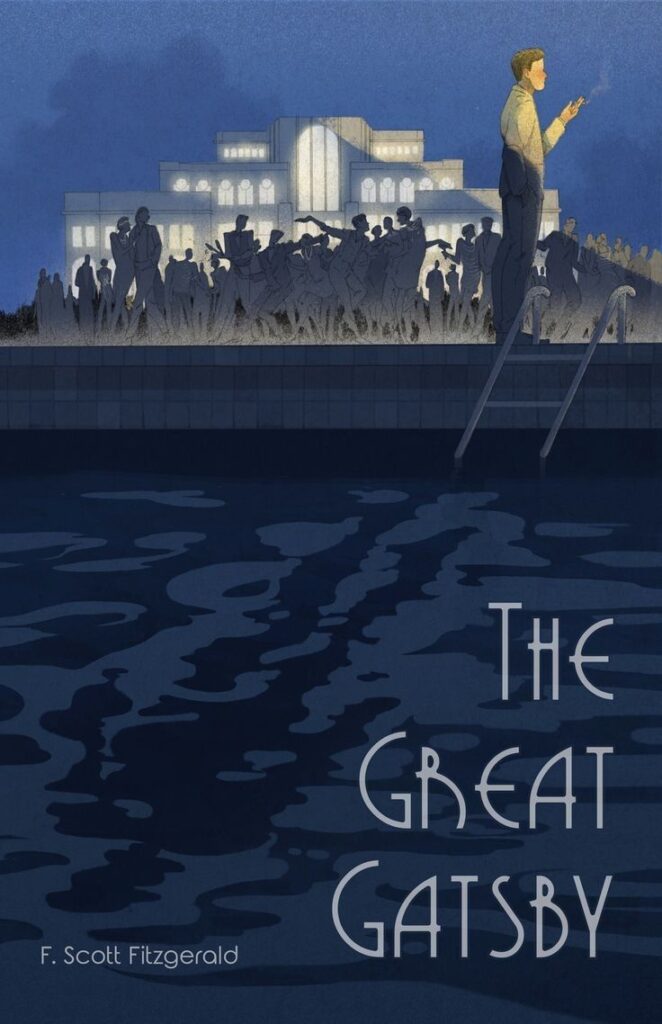
If you’ve ever heard of The Great Gatsby, you probably associate it with glittering parties, jazz-age glamour, and tragic romance. But reading it—the real novel by F. Scott Fitzgerald—is more like looking into a shattered mirror that reflects dreams, illusions, longing, and heartbreak.
This article brings you a comprehensive, rich The Great Gatsby book summary. We’ll walk through the story, meet its unforgettable characters, unravel its symbolism, and reflect on why this book continues to haunt readers nearly a century after it was first published. On Riya’s Blogs, I’ve tried to capture both the beauty and the bitterness of this tale.
🌇 Setting the Scene — 1920s, Jazz Age, and the World of East Egg vs West Egg
The story of The Great Gatsby is set in the early 1920s, in the aftermath of World War I, during a period of booming prosperity, wild ambition, and moral restlessness in America.
The narrator, Nick Carraway, moves from the Midwest to New York to try his luck in the bond business. He rents a modest house in the fictional village of West Egg on Long Island — among the newly rich, the flashy, the dreamers.
Directly across the water lies East Egg, where the old aristocracy resides — people born into wealth, accustomed to inherited status and social polish.
This spatial divide sets the stage for class tensions, hidden longing, and illusions of grandeur. It’s against this backdrop that the story of Jay Gatsby unfolds — a man whose mansion towers over West Egg, and whose eyes are fixed across the bay.
🎩 Enter Gatsby, Daisy, Tom — And the Dream That Haunted Them
– Nick Carraway: The Observer
Nick becomes our eyes and ears. He narrates everything: the glamour, the gossip, the heartbreak, the tragedies. Through him, we get a sense of what the American Dream looked like in the Roaring Twenties — and how quickly it could crumble.
Nick is morally more grounded than many around him. He’s trying to understand this new world of excess, wealth, illusion, and underlying emptiness.
– Jay Gatsby: The Dreamer, The Illusionist
Gatsby bursts onto the scene not as a quiet neighbor but as a mystery: extravagant mansion, lavish parties every weekend, guests, music, champagne flowing, fireworks — yet no one seems to know much about him.
His past is hazy. His wealth — dubious. His purpose — centered entirely on one person: Daisy Buchanan. Gatsby isn’t wealthy just for luxury. He’s wealthy to win Daisy. To recreate an ideal past. To show that he belongs. That’s the tragedy of Gatsby: he builds castles in the air, hoping Daisy will inhabit them with him.
– Daisy Buchanan & Tom Buchanan: Old Money, Carelessness, and Fragile Hearts
Daisy lives in East Egg. She represents old money, inherited privilege, aristocratic polish. To Gatsby, she is the light at the end of the dock — a “green light,” symbolizing hope, longing, and an unattainable future.
Tom, her husband, is brutish, arrogant — a product of old money entitlement. He’s having his own affair, living in hypocrisy: condemning Gatsby’s background while maintaining his own immoral lifestyle.
Together, Daisy and Tom embody what the novel criticizes: wealth without conscience, glamor without substance, carelessness without responsibility.
🕰️ The Story Unfolds — Key Moments in The Great Gatsby
Here’s how the plot of The Great Gatsby moves — not with slow build-up, but with emotional surges, illusions cracking, and tragedy lurking just beneath the glitter.
Nick Meets Gatsby — Parties, Mystery, and Unspoken Longing
Nick hears rumors. He sees parties. Extravagant homes. Hordes of guests. But there’s something sad behind the spectacle. He finally meets Gatsby — and the man is surprisingly reserved, quietly longing, as if the parties are more a performance than happiness.
Gatsby doesn’t throw parties for fun. He throws them hoping Daisy will wander in one day, recognize him, decide to return. That hope — tragic and beautiful — becomes the pulse of the novel.
A Reunion — Hope Rekindled, Illusions Revived
With Nick’s help, Gatsby arranges a meeting with Daisy. Their reunion is awkward, charged, heartbreaking and hopeful all at once. Daisy is amazed at Gatsby’s world; Gatsby is amazed that his dream is real, if only for a moment.
Then comes the confession. Gatsby wants Daisy to admit she never loved Tom. To declare that the past wasn’t real — that she only loved him. It’s a demand built on an illusion, a yearning for a past that can’t truly be resurrected.
The Confrontation — Lies, Reality, and the Collapse of Illusion
On a sweltering summer day, tension explodes. Gatsby and Tom, Daisy and Jordan and Nick — everyone ends up together. The truth splinters. Tom confronts Gatsby openly, accusing him of being a bootlegger, making his money through shady, illegal means. His wealth is tainted. Daisy sees the crack. Gatsby’s dream begins to fall apart.
Gatsby demands Daisy say she never loved Tom — and that she only ever loved him. Daisy falters. She can’t commit. She can’t walk away from her roots, from her status, from the safety net. Reality overpowers fantasy.
A Deadly Accident — Symbol of Consequence
Shortly afterward, tragedy strikes. Daisy, driving Gatsby’s yellow car with Gatsby beside her, accidentally hits and kills Myrtle Wilson, the mistress of Tom. The accident shatters illusions. Wealth and glamor can’t protect you. You can’t outrun consequences.
Tom, in a cruel turn, allows Gatsby to take the blame — though everyone knows Daisy was driving. Money, power, and privilege shield the guilty.
The Tragedy — Gatsby’s Death and Moral Collapse
In the aftermath, grief and guilt torment other characters. George Wilson, Myrtle’s husband, devastated and misled, hunts down Gatsby and kills him — then kills himself. Gatsby dies — lonely, betrayed, with no funeral party, no mourning guests. His mansion stands empty. His dream lies in ruins.
Nick, disgusted with the emptiness, the carelessness, the moral decay of East Egg society, retreats back to the Midwest. He reflects on Gatsby’s life, on what his dream really meant, and on how the American Dream, for many, is just an illusion.
⚠️ Themes & Symbols — What The Great Gatsby Actually Talks About
A simple reading of events gives you drama. But the power of The Great Gatsby book summary lies in its deeper layers: symbolism, social critique, moral questioning. Here are the themes that make the novel timeless.
🎯 The American Dream — Ideal vs Reality
At its heart, The Great Gatsby is a critique of the American Dream. Gatsby rises from humble origins to fabulous wealth — a self-made man. But wealth doesn’t bring acceptance. Social status doesn’t grant love. His dream — of recapturing the past, of being worthy of Daisy — ends in tragedy. The novel suggests that the Dream, as popularly imagined, is flawed, hollow, and often unreachable.
Gatsby’s relentless pursuit of money and status is not enough. Because behind the dream lies social stratification, hypocrisy, moral decay.
🧱 Old Money vs New Money — Class, Status, and Invisible Divides
The novel draws a stark contrast between “old money” (East Egg) and “new money” (West Egg). Despite Gatsby’s wealth, he remains an outsider — because he lacks the pedigree, the heritage, the social polish. Daisy and Tom are old-money aristocrats; their carelessness, their privilege, their sense of entitlement reflects a class that transcends wealth.
Gatsby’s parties, his mansion, his extravagance — they can’t mask the underlying insecurity of “new money.” He tries to buy love, acceptance, status; but some things can’t be purchased.
💔 Illusion vs Reality — Dreams That Shatter
Gatsby’s entire life is built on illusion: his persona, his wealth, his parties, his love for Daisy. But illusions crumble when confronted with truth. Daisy isn’t the ethereal woman of memory; she’s flawed, worldly, uncertain. The past isn’t resurrected; it’s confronted — and found wanting.
Through Gatsby’s arc, the novel shows how human longing, nostalgia, and obsession can blind us. And how chasing illusions can end in heartbreak.
🥀 Moral Decay, Carelessness & The Cost of Privilege
Beneath the glitter — emptiness. Behind the glamor — moral decay. Characters like Tom and Daisy exemplify a kind of careless cruelty: they use people, break hearts, cause death — and retreat behind their wealth, unaffected. Gatsby may have illusion, but his roots are more honest. The established aristocracy? They’ve earned their privilege, and with it, the right — they think — to ignore consequences.
The novel doesn’t present a moral hero. Instead, it presents flawed people, moral ambiguity, and the tragic cost of carelessness.
💡 Symbolism — The Green Light, The Valley of Ashes, The Eyes of Dr. T. J. Eckleburg
A beautiful story hides deeper meanings.
- The green light across the bay — at the end of Daisy’s dock — becomes the emblem of Gatsby’s hope and longing. It represents the future he yearns for, the dream he pursues, the love he hopes to reclaim. Yet it remains distant, elusive.
- The Valley of Ashes — a grey wasteland lying between West Egg and New York — stands in stark contrast to the glittering mansions and lavish parties. It’s where the consequences of wealth, industrialization, social inequality, and moral neglect accumulate. It symbolizes decay behind the façade.
- The eyes of Doctor T. J. Eckleburg — on a billboard looming over the Valley of Ashes — act as a symbolic moral conscience. Watching, judging the decay, the moral emptiness, the spiritual bankruptcy beneath the glamorous veneer. They remind us that beneath all the glitz, there’s a void.
These symbols give the book weight beyond its romance and tragedy. They elevate The Great Gatsby from a mere story to a social critique — a haunting portrayal of a world seduced by wealth, corrupted by privilege, broken by illusions.
💔 Characters That Stay With You — Faces Behind the Dream
In a story filled with parties and glamor, what resonates most is the humanity — the longing, the regret, the pain.
- Jay Gatsby — A tragic dreamer, beautiful in his longing, mythic in his ambition, heartbreaking in his failure. His life is a monument to hope, but also to the danger of obsession.
- Nick Carraway — Our anchor, our moral compass. Through his eyes we see illusion crack. Through him we feel disgust, pity, sadness — but also compassion and understanding.
- Daisy Buchanan — Glittering as a pearl, but fragile as glass. Her voice, her charm, her wealth — they attract, but they also entrap. She is the living embodiment of beauty, privilege, and emptiness.
- Tom Buchanan — Arrogant, entitled, careless. Tom doesn’t need to care. Wealth shields him. His sense of superiority and disregard for consequences make him one of the cruelest characters — because his cruelty is subtle, normalized, protected.
- Jordan Baker, Myrtle Wilson, George Wilson — supporting characters, each representing different social strata, aspirations, vulnerabilities. Through them the novel sketches the undercurrents of inequality, desperation, illusion, and moral collapse.
But in the end, the real character of The Great Gatsby is not a person — it’s a world. A world defined by excess and emptiness, ambition and disillusionment, longing and tragedy.
🌙 Why The Great Gatsby Still Matters — Then, Now, Always
Even decades after its publication, The Great Gatsby remains timeless. Because:
- The allure of dreams — and their fragility — never fades. Everyone knows what it is to hope, to long, to yearn. Gatsby’s green light could symbolize any lost love, any unreachable aspiration, any dream deferred.
- The critique of wealth, privilege, social stratification remains relevant. Even today we see gaps between inherited wealth and new money; between social acceptance and financial success; between façade and reality.
- The moral questions of responsibility, carelessness, and consequence — they’re universal. The story warns that glamor and wealth can mask emptiness, that indulgence may come at the cost of humanity.
- The tragedy of chasing the past — of believing you can recreate what once was — teaches a hard lesson: the past is gone. What we cling to may be nothing more than memory. What we build on illusions may crumble under reality.
In that sense, The Great Gatsby is not just a novel. It is a mirror — of society, of dreams, of ourselves.
📝 My Reflections — Reading The Great Gatsby on Riya’s Blogs
When I first read The Great Gatsby, I expected romance and glamour — but I found grief. A beautiful grief. A sorrow that lingers.
Gatsby’s longing struck me — not because it’s unrealistic, but because it’s achingly human. Haven’t we all loved someone or something so deeply that we were willing to rebuild our entire lives for them? Haven’t we all held onto dreams so tightly that we forgot the difference between hope and delusion?
And Daisy — she made me angry, and sad. She was gentle yet cruel, charming yet hollow. She reminded me how privilege can protect cruelty, how wealth can mask emptiness, how comfort can silence conscience.
Nick — honest, observant — became my guide through this world. Through him, I saw the façade crack. I saw what lies beneath shimmering parties and sparkling champagne.
Even the minor characters — the desperately hopeful, the morally lost, the soul‑wounded — they made me realize that Gatsby’s tragedy wasn’t just personal. It was universal. It was cultural. It was about society.
And that’s why The Great Gatsby doesn’t feel dated. It feels like the echo of dreams we still chase, mistakes we still repeat, illusions we still build.
On Riya’s Blogs, I want readers — whether you’ve read Gatsby before or are hearing about it for the first time — to feel something. To question. To reflect. To remember: that behind every glittering façade might lie a void.
🧭 Final Thoughts — The Great Gatsby Summary, and What It Leaves Behind
If I were to sum up The Great Gatsby in one sentence: it is a beautiful, tragic testament to the cost of dreams corrupted by illusion, wealth, and carelessness.
Gatsby was “great,” not because of his wealth or his parties, but because of his extraordinary capacity to hope — even when hope was delusional. His tragedy lies not just in his death, but in the fact that his dream died too. And in that death lies the novel’s power: to remind us that sometimes, the most dangerous illusions are the ones we build ourselves.
Whether you read The Great Gatsby as a romantic tragedy, a social critique, a moral fable or a mirror to your own hopes — it remains, after all these years, hauntingly relevant.

Want to read a bit more? Find some more of my writings here-
30 Dark Secrets Quotes That Will Give You Chills
The Handmaid’s Tale Book Summary
International Holocaust Remembrance Day Messages — January 27
I hope you liked the content.
To share your views, you can simply send me an email.
Thank you for being keen readers to a small-time writer.