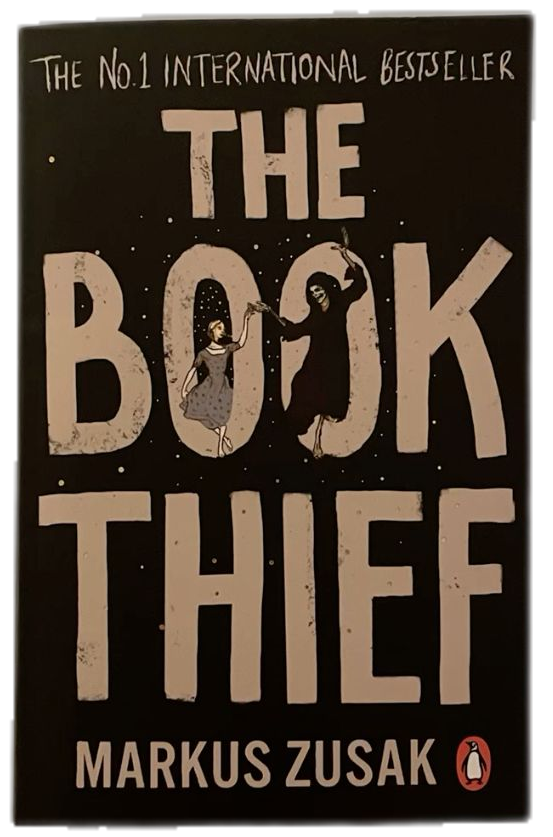
The Book Thief is a novel by Markus Zusak, set in Nazi Germany during World War II. Its narrator is not a human — but Death itself, giving the story a haunting, reflective tone from the start.
At its core, the novel explores the power of words — their ability to destroy, and to heal; the strength of human connection in the darkest times; and the resilience of hope when loss and hatred seem overwhelming. It’s about a little girl who becomes a “book thief” — stealing books, devouring words — and learning to use stories as a shield and a refuge.
In writing this summary, I want to honor those themes, to help new readers understand why The Book Thief is so deeply loved — and why it stays in the reader’s heart long after the last page.
🧒 Meet the Protagonist: Liesel Meminger
The story begins with a little girl — Liesel Meminger. In 1939 Germany, Liesel travels with her mother and younger brother Werner to a small town near Munich, called Molching — to live with foster parents. On that train ride, tragedy strikes: Werner dies suddenly. Liesel is left traumatized, grief-stricken. It’s a cruel introduction to loss for someone so young.
At Werner’s burial foot, Liesel spots a small book lying forgotten in the snow — The Gravedigger’s Handbook. Though she cannot read yet, she instinctively steals it. That moment — seemingly small — marks the beginning of her journey, the moment she becomes the “book thief.”
Because she doesn’t know how to read, the stolen book is just a heavy object, but it becomes a symbol — a seed of curiosity, defiance, longing. Through that book, Liesel begins to grasp the idea that words — written, spoken — carry power.
When she arrives in Molching, she is placed with foster parents: kind-hearted Hans Hubermann (Papa) and stern, rough-edged Rosa Hubermann (Mama). At first, Liesel doesn’t trust them. She is haunted by nightmares of Werner, guilt, grief. The world seems cold and unwelcoming.
But Hans becomes more than a foster father — he becomes safety, warmth, hope. One night, when Liesel wakes from a nightmare, Hans sits with her and offers comfort. Gradually, through patience and kindness, he begins teaching her to read — using the book she stole. Night after night, Liesel learns letters, words, sentences. And as she learns, a whole new inner world opens up to her.
That transformation — from illiterate girl to reader, from fear to wonder — becomes one of the novel’s most beautiful arcs.
🏠 Life on Himmel Street — Safety, Friendship, and Stealing Words
As Liesel settles into Molching, she finds friendship and childhood again — with neighbor boy Rudy Steiner. Rudy is cheeky, always full of energy, mischief and loyalty. He idolizes the American athlete Jesse Owens, runs races, dreams big. His companionship offers Liesel small joys, laughter, and a sense of belonging again.
For Liesel, the stolen book at Werner’s grave was only the beginning. Nazi Germany is descending into censorship, fear and propaganda — and in 1939‑40, public book burnings are common. During one such bonfire, Liesel witnesses the destruction of countless books, knowledge, stories — and it shakes her deeply. In that tragic bonfire, she watches hatred consume words and worlds.
When the fire dies down and crowds disperse, Liesel instinctively reaches into the ashes and rescues one scorched book — spirited it away under her coat. That act — quiet, defiant — is not just theft, but rebellion: a refusal to let war erase stories, memories, voices.
From then on, Liesel begins stealing more — not out of greed, but out of love for words, for memory, for resistance. Whether from Nazi bonfires, the wealthy household of the town mayor, or wherever books can be found — Liesel becomes “the book thief.”
One of the pivotal relationships that grows from this love of reading is with the mayor’s wife, Ilsa Hermann. When Liesel delivers laundry for her foster mother Rosa to the mayor’s mansion, she is drawn to the mansion’s private library — rows of books, hush, stories waiting. Ilsa allows Liesel to read, encourages reading. Over time, their relationship becomes complex, emotional — one of connection through words rather than blood or social standing.
Books become Liesel’s secret sanctuary — a way to process grief, to dream, to rebel silently. Through words, she finds strength, identity, comfort.
🚨 A World in Turmoil — War, Fear, and Hidden Humanity
But outside the relative safety of Himmel Street, the world darkens. Nazi propaganda, anti-Semitic persecution, war — these forces encroach upon ordinary lives. The small town of Molching cannot remain untouched.
Into the Hubermann household comes a secret — a Jewish man named Max Vandenburg. Max is a friend of Hans’s from World War I — Hans had once saved Max’s father. Out of that old promise, and out of moral courage, Hans and Rosa decide to hide Max in their basement, risking everything.
Max’s arrival transforms the meaning of words for Liesel. Here is a human life — a persecuted life — saved not by politics, not by power, but by compassion, empathy and quiet courage. Max and Liesel, both broken in their own ways, form a deep bond. Through nights of fear, hiding, and rationed hope, they share stories, nightmares, dreams. Max, in an act of both defiance and tenderness, writes a book for Liesel — using pages painted over from a hateful propaganda book (ironically, the author of that book), transforming hate into hope with ink and words.
That act — painting over hatred with words of connection — becomes one of the novel’s most powerful metaphors. It shows that language, which can be twisted to fuel evil, can also be reclaimed, remade, used to heal, to remember, to resist.
As war intensifies — public paranoia grows, bombings start, Jewish persecutions escalate — the danger and urgency of every day becomes more real. The Hubermanns live in constant fear. Liesel’s stolen books, her hidden friend, her love for words — all can cost lives.
And yet — in secret basements, in stolen pages, in whispered stories — hope survives.
💔 Loss, Tragedy, and Survival — The Bombing of Himmel Street
As the war reaches its darkest intensity, Molching becomes a target. Air raids, bombings, uncertainty. For the residents of Himmel Street — for Liesel — life becomes fragile, precarious.
Then comes the unthinkable: a bombing raid that destroys Himmel Street completely. The homes are razed. Families are killed. Among them are Liesel’s foster parents Hans and Rosa, and her dear friend Rudy Steiner — the boy she ran races with, the boy who made her laugh. The neighborhood is lost, lives broken.
But Liesel survives. Why? Because during the raid she was in the basement, writing — recounting her story, pouring her grief, memory, love into words. In that basement, she clung to her journal, to her writing — a fragile lifeline. When she emerges, the world above is ashes, rubble, silence. Above ground lies death; downstairs lies memory.
She finds the bodies of those she loved. The physical presence is gone. But their memory — their stories — live on in Liesel, in her grief, in her words. That act of survival — of living despite horror — becomes a testament to human resilience, to the power of memory, to the strength of words.
✍️ Rebuilding from Ashes — Writing, Memory, Life After War
After the tragedy, Liesel is taken in by the mayor’s wife, Ilsa Hermann. Despite all loss, despite the ruins, there remains kindness, compassion, and human kindness carried forward by unlikely people. Ilsa becomes a kind of haven, a bridge to a future beyond rubble.
In time, war ends. The bombs stop. The world slowly, painfully begins to heal. Liesel herself survives, grows up. She eventually moves to Australia, starts a new life — but carries within her the scars, memories, love, loss of those years.
Yet the story does not end in despair. In the novel’s conclusion — narrated once again by Death — we follow Liesel’s life until old age. When Liesel dies many decades later, Death visits her. He reveals that he has kept her story, preserved it — as a testament to humanity. When he looks at her life, at her words, he acknowledges with sorrow and wonder that humans can contain both light and darkness. “Humans,” he says, “are filled with such contradictions — beauty and horror, love and hate — and that is what haunts me.”
Through Liesel’s words — through The Book Thief, the book she writes — she ensures that memories, stories, tragedies, hopes are not lost. She resists oblivion. She preserves humanity.
🌟 Themes that Echo Beyond the Pages — Why The Book Thief Matters
Why does The Book Thief resonate so much with readers around the world? What makes it more than a book about war and tragedy — but a story about humanity, words, resilience? On Riya’s Blogs, I see it as a timeless and essential tale. Here are some of the themes that make the book timeless:
✒️ The Power of Words — To Destroy, to Heal, to Resist
Words in The Book Thief are double‑edged: used by tyrants to spread hate, fear, propaganda — but also used by Liesel and Max to heal, remember, resist. Liesel’s first stolen book, Max’s painted-over manuscript, the stories Liesel reads aloud during air raids — all show that language can be a haven, a weapon, a source of hope.
In a world determined to silence, control, destroy — stealing, reading, writing books becomes an act of rebellion, an affirmation of humanity.
🤝 Compassion, Humanity, Moral Courage in Dark Times
The characters who risk everything to shelter Max, to teach a child to read, to keep kindness alive — they show that even in cruelty, war, oppression — compassion can survive. Hans Hubermann’s quiet courage, Rosa’s rough love, Max’s resilience, Ilsa Hermann’s sympathy — all reflect how ordinary people can become extraordinary when they choose empathy over fear.
The novel reminds us: heroism doesn’t always roar. Sometimes — it whispers, shields, hides, reads to frightened neighbors in a basement during bombings. Sometimes — it is gentle, human, flawed.
🖤 Loss, Grief, and Memory — The Cost of War, and the Strength to Survive
War takes lives — loved ones, innocence, time, childhood. Liesel loses her brother, then later loses her foster parents, friends, community. But through memory and storytelling, she preserves them. The act of remembering becomes survival. The act of writing becomes resistance to oblivion.
The trauma, the grief — raw and heartbreaking — doesn’t vanish. But through empathy, through stories, through words — there is a kind of healing, a way to carry love forward, even when bodies are gone.
🕊️ Hope, Resilience, and the Human Spirit — Even When Everything Falls Apart
Even after the bombing, after loss, after despair — Liesel survives. She writes. She grows old. She lives. And Death, the narrator, keeps her story. That, in itself, is an affirmation: that human lives, human stories, matter. That even in the darkest times — not because the darkness disappears — but because people choose kindness, memory, love — the human spirit can endure.
This message feels especially precious today — when the world seems chaotic, when hatred and conflict continue. The Book Thief reminds us: preserving stories, preserving empathy, preserving humanity — may be the greatest rebellion, the greatest hope.
💭 What Many Readers Feel — Reactions & Reflections
Since its publication, The Book Thief has touched hearts globally. Many readers talk about it as one of the most emotionally intense and beautiful stories they ever read. On forums and book networks, you often see sentiments like:
“The Book Thief is genuinely one of my favourite books. I think I’ve read it 5 times now, and I’m never getting tired of it.”
“It’s a tragic page‑turner for sure.”
For some, the novel’s slow build — the quiet moments of reading, living, waiting — may feel uneventful; as one reader noted, “the story is slow‑paced … the last 100 or so pages are absolutely enthralling.”
What resonates most, again and again, is the combination of cruelty and kindness, darkness and light, loss and love — framed through the innocence of a child, the empathy of a foster father, the risk of sheltering a Jew, and the simple power of a stolen book.
On Riya’s Blogs — as I reflect personally — I find that The Book Thief doesn’t offer comfortable closure. It doesn’t promise that war ends neatly, or that grief disappears. But it offers something perhaps more lasting: awareness, memory, empathy. A sense that stories — real stories — matter.
📚 Why The Book Thief Is Timeless — What Makes It More Than Just a War Novel
When I think about The Book Thief, what strikes me is that it’s not just a historical novel or a wartime tragedy. It’s a meditation on humanity, words, love, memory. It’s a book about what it means to be human when everything around you is inhuman.
This novel resonates because:
- It shows that even the smallest acts — reading a stolen book, comforting a child, hiding a friend — can be acts of radical kindness and resistance.
- It gives voice to the powerless, to the forgotten, to children and Jews and ordinary Germans — and shows that behind every statistic of war, there were human hearts beating, afraid, loving, dreaming.
- It demonstrates that language matters — that stories can preserve identity, hope, memory. That books are not just paper and ink — but vessels of humanity.
- It doesn’t sugarcoat. It doesn’t shy away from loss, grief, death. Yet it doesn’t surrender to despair. It insists on love, memory, survival.
As a story, it is heartbreaking and beautiful. As a message, it is hopeful and eternal.
✍️ Personal Reflection — Why The Book Thief Matters to Me (and Maybe to You)
On Riya’s Blogs, I often celebrate books that leave me changed. The Book Thief is one of those rare stories that stay with you long after you finish reading.
I think often about Liesel — a child who loses so much, yet finds refuge in words; who steals to learn, to dream, to rebel; who survives heartbreak and tragedy but holds on to love, memory, humanity.
I think about Hans — the kind foster father whose moral compass remains true when the world around him turns cruel. About Rosa — rough in words but fierce in love and loyalty. About Max — a man hiding from hate, clinging to hope. About Ilsa Hermann — who lets a child into her library, bridging silence, guilt, loneliness.
And I think about the power of stories. In a world of hate, where fear becomes normal, stories — written or read — become resistance. Stories become solace. Stories become memory.
Maybe that’s why The Book Thief matters — because in its words we find hope, empathy, courage. Because in Liesel’s stolen books and stolen moments we see a world where humanity still flickers, even in darkness.
If you’ve never read it — I hope this summary inspires you to pick it up. If you have — I hope this gives you a new way to see it, remember it, cherish it.
Want to read a bit more? Find some more of my writings here-
Never Lie by Freida McFadden — A Deep Dive
Top 25 Quotes About Time and Its Value
I hope you liked the content.
To share your views, you can simply send me an email.
Thank you for being keen readers to a small-time writer.