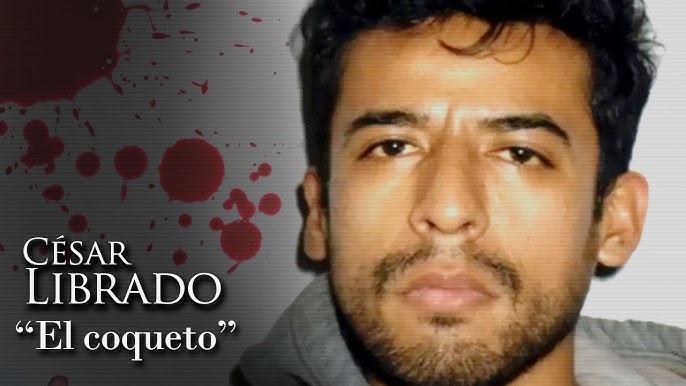
In the early 2010s, Mexico City was shaken by one of its most chilling modern serial killer cases. The perpetrator was not a shadowy stranger but a familiar figure — a public bus driver. Known as “El Coqueto” (Spanish for “the flirt”), César Armando Librado Legorreta used his position of trust and routine authority to lure unsuspecting women onto his route — where their journey would end in horror.
Early Life and Background
César Armando Librado Legorreta was born in 1981 in Mexico. Before his crimes were exposed, he lived an unremarkable life: a low-income upbringing, limited education, and steady employment as a public transportation driver in the Valle de México metropolitan area, near Naucalpan and Cuautitlán Izcalli, State of Mexico.
Colleagues described him as quiet and reserved, sometimes friendly, sometimes distant — earning him the nickname “El Coqueto” among coworkers for his flirtatious nature with women passengers and other drivers. Nothing about his demeanor suggested that he would become one of Mexico’s most feared modern predators.
The Crimes: Targeting Women on the Bus
Between 2010 and early 2012, Legorreta exploited his late-night route on the Mexibús line (connecting Mexico City suburbs with the State of Mexico) to assault, rape, and murder women passengers.
His pattern was chillingly consistent:
- Late-night routes – He selected women traveling alone, typically during the last trips of the evening.
- Isolation – After dropping off other passengers, he would deviate from his official route.
- Assault – He would drive to secluded locations, rape his victims, and then strangle them to death.
- Disposal – Bodies were often dumped in remote areas such as fields, empty lots, or ravines within the Naucalpan–Cuautitlán corridor.
Investigators later confirmed that at least seven women were murdered using this same method, though Legorreta confessed to more than 20 victims, claiming many assaults went unreported because the victims survived but were too afraid to come forward.
Discovery and Investigation
The breakthrough came in early 2012, after the discovery of several female bodies in areas serviced by the same bus route. Local residents and relatives of missing women began to identify a pattern — all victims were last seen boarding public transport late at night.
Authorities from the Procuraduría General de Justicia del Estado de México (PGJEM) began cross-referencing the routes, vehicle records, and driver logs. They eventually focused on one driver whose schedule and route overlapped with every disappearance: César Armando Librado Legorreta.
After surveillance and mounting evidence, El Coqueto was arrested in February 2012 in Naucalpan. During interrogation, he gave detailed confessions describing his crimes, often with chilling indifference.
The Infamous Escape
Just days after his arrest, the story took an astonishing twist.
While being transferred by police officers, El Coqueto managed to escape custody, injuring himself in the process but vanishing into the dense sprawl of the Mexico City metropolitan region.
His escape humiliated the authorities and sparked national outrage. Newspapers labeled it a “disaster of police negligence.” A massive manhunt was launched, involving hundreds of officers, checkpoints, and surveillance operations.
Within three days, he was recaptured in Tlalnepantla, injured and hiding in a relative’s home. He had suffered a spinal injury during his escape, which left him partially paralyzed and confined to a wheelchair for the rest of his life. This dramatic episode made him one of Mexico’s most infamous fugitives of the 21st century.
Trial and Sentencing
Following his recapture, César Armando Librado Legorreta was charged with multiple counts of rape, murder, and kidnapping. The court found him guilty of at least seven murders, though prosecutors argued there were more victims whose remains could not be conclusively linked.
In March 2014, Legorreta was sentenced to 240 years in prison, one of the longest sentences in Mexican legal history at the time. Under Mexican law, the effective term served is capped (usually at 60 years), but the symbolic total underscored the gravity of his crimes.
Psychological Profile: The Making of “El Coqueto”
Experts who examined Legorreta’s behavior identified him as a psychopathic sexual predator.
Unlike many serial offenders motivated by power or fame, he seemed driven by impulse and opportunity, not by a long-standing compulsion to kill.
He saw his victims as objects of pleasure and control rather than as individuals, demonstrating complete emotional detachment.
Investigators noted his calm demeanor during confessions — he described his assaults as routine, using phrases like “ellas no decían nada” (“they didn’t say anything”), underscoring his lack of empathy.
His familiarity with the bus routes and knowledge of secluded industrial zones allowed him to operate undetected for nearly two years, blending into the city’s chaotic public transport ecosystem.
Public Reaction and Media Impact
The State of Mexico has long suffered from alarming rates of gender-based violence, and the “El Coqueto” case reignited public fury.
Activists and journalists condemned the systemic failures that allowed a public employee to commit serial sexual murders undetected.
Spanish-language outlets such as El Universal, Milenio, and La Jornada provided wall-to-wall coverage, labeling the case a “national shame.”
The story was later adapted into true-crime television programs and featured in investigative documentaries focusing on feminicide in Mexico.
The case became symbolic of:
- Violence against women in public spaces
- Institutional negligence in law enforcement
- Public transportation safety failures
The phrase “Nunca más un Coqueto” (“Never again a Coqueto”) emerged in feminist protests as a call for reform in Mexico’s public security systems.
Life After Conviction
Since his sentencing, Legorreta has been imprisoned under strict security due to the notoriety of his case. He remains paralyzed and wheelchair-bound as a result of his botched escape attempt.
There have been no confirmed public interviews since his incarceration, but prison officials describe him as quiet, withdrawn, and occasionally manipulative — still showing no remorse for his victims.
Legacy and Broader Context
The “El Coqueto” case stands as a grim reflection of Mexico’s gender violence crisis. Between 2010 and 2020, thousands of women were murdered across the country, many in unsolved cases.
Legorreta’s crimes exposed how predators could exploit systemic gaps — weak oversight, underfunded investigations, and societal desensitization — to operate in plain sight.
The case has since been studied by criminologists and feminist scholars as an emblematic instance of urban predation, where familiarity, trust, and routine environments become weapons in the hands of psychopaths.
Conclusion
César Armando Librado Legorreta — “El Coqueto” — will forever be remembered as one of Mexico’s most notorious modern serial killers. A man who turned his position as a city bus driver into a tool for terror, he manipulated the vulnerabilities of ordinary women simply trying to get home.
His story isn’t just about one man’s monstrosity — it’s about the societal and institutional failure that allowed his crimes to continue.
The public outrage his case provoked continues to echo in Mexico’s push for safer public transport and justice for victims of gender-based violence.
Want to read a bit more? Find some more of my writings here-
Book Review: Reckless by Lauren Roberts
Bruce McArthur: The Toronto Landscaper Serial Killer
Book Review: “Powerful” by Lauren Roberts
I hope you liked the content.
To share your views, you can simply send me an email.
Thank you for being keen readers to a small-time writer.