Rating: ⭐⭐⭐⭐✩ (4.2/5)
Publication date: May 1, 2026
Genre: Dystopian science fiction thriller with elements of Horror.
Perfect for readers who enjoy: The Handmaid’s Tale, Never Let Me Go, Red Rising, The Expanse, and emotionally charged dystopian fiction that wrestles with bio-ethics, motherhood, power, and survival. Especially a fun read for science nerds.
Buy the book
International link:
https://mybook.to/Harvested
Introduction: What if the future did not save us, but stripped us down?
Let me put it this way. Imagine you wake up one night, heavy with hope, carrying a child, still half in the softness of sleep. Then a light comes for you. Not the gentle kind. Not the kind that belongs to morning. The kind that takes. The kind that does not ask. The kind that changes your life before you even understand what is happening.
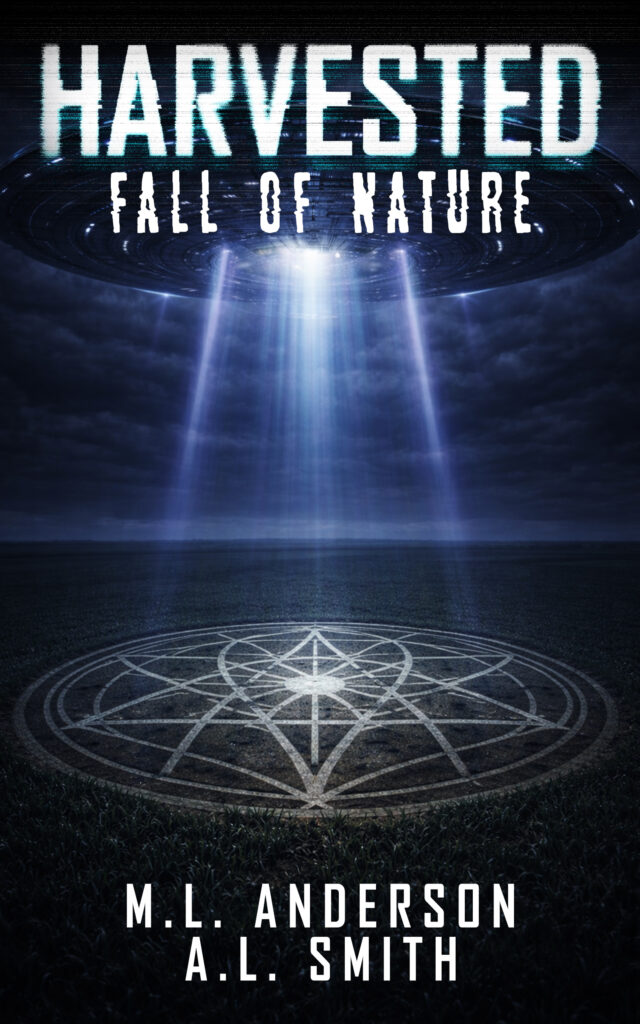
That is the energy Harvested: Fall of Nature opens with, and honestly, it does not let go.
This is the kind of dystopian science fiction that does more than build a strange world. It takes a knife to questions we are already quietly asking in real life. How far should science go? What happens when human beings stop respecting limits? What if perfection becomes a system? What if survival itself turns cruel? What if nature is no longer something we live with, but something we have broken so completely that we must steal from the past just to keep the future alive?
Michael L. Anderson and Allison L. Smith create a world that feels frightening not because it is impossible, but because parts of it feel dangerously believable. Genetic castes. Manufactured births. Hollow beauty. Synthetic food. Collapsing ecosystems. Human beings redesigned until they can barely sustain themselves. It is bold, cinematic, and very clearly built by writers who are not just interested in action, but in the moral weight behind the action.
And that is what makes this book stick.
The story’s emotional center: a mother, a loss, and a world that has forgotten its soul
At the center of Harvested: Fall of Nature are Kristi, Hunter, and Shad, and I think that is one of the smartest choices the book makes.
Yes, this is a dystopian thriller. Yes, there are strange systems, terrifying discoveries, futuristic societies, rebellion, science, and deep ethical tension. But underneath all of that is one very human heartbeat. A mother who has lost something she cannot simply accept losing.
That emotional engine gives the book its force.
Kristi is not just moving through a strange world as a witness. She is moving through it with grief in her chest and purpose under her skin. That matters. It turns the story from a cool sci-fi concept into something intimate and urgent. Her pain gives the book its fire. Her refusal to break gives it movement. Her motherhood gives the bio-ethical themes real weight, because this is no longer just about theories or future systems. It becomes about the body, about choice, about violation, about what happens when a society decides it knows better than love. And I believe Shad and Hunter are her perfect partners.
And over coffee, that is exactly the kind of thing I would say makes a dystopian novel work. Not just the world-building. Not just the clever premise. The emotional truth.
This book understands that.
A world that is polished on the surface and rotten underneath
One of the strongest things about Harvested: Fall of Nature is its atmosphere.
The world here is not messy in an obvious way. It is not all rubble and smoke and constant ruin. In fact, parts of it are polished, beautiful, organized, elegant even. That is what makes it disturbing. This is not chaos wearing a monster’s face. This is control wearing a beautiful one.
You can feel the horror of that in the way the book handles engineered castes, altered humanity, and food systems. Even the land itself tells a story. Nature has not just been ignored. It has been damaged, manipulated, and replaced until the system holding society together feels brittle and deeply unnatural.
There are moments in the novel where this hits especially hard. The idea that famine is no longer simply a natural crisis, but something tied to design, power, and dependence. The idea that survival is being managed rather than healed. The idea that this future is not thriving, but feeding off what it destroyed. That is where the book’s bio-ethics angle becomes especially powerful. It asks not only, “Can we do this?” but “What are we becoming when we do?”
And that question hangs over the story beautifully.
The science fiction here has teeth
Some sci-fi books give you cool tech and ask you to enjoy the ride. This one definitely gives you the ride, but it also gives the tech consequence.
Genetic engineering is not just a background element here. It shapes identity, hierarchy, control, reproduction, power, and even worth. The book keeps returning to the cost of redesigning life. Not in a preachy way. Not in a way that feels like a lecture. More in a way that quietly keeps tightening the knot in your stomach.
That is where I think the authors really succeed.
There is a sharpness to the ideas. You can tell this world was not built casually. It was thought through. The social systems feel layered. The science feels grounded enough to be unsettling. The ethical tension is always close. This is not empty dystopian decoration. It is a world built on choices that make sense in a chilling way.
And then there is the title itself. Fall of Nature. It sounds dramatic at first, but once you move deeper into the story, it starts to feel exact. The fall is environmental, yes. But it is also moral. Emotional. Human. The fall is not just in forests and food chains. It is in what people decide they can justify.
The pace: fast, tense, and easy to stay inside
This book moves.
It has the energy of a thriller, and that helps a lot because the themes are heavy. The story does not sit still for too long. It pushes forward with enough tension that you keep wanting “just one more chapter.” There is danger, discovery, pursuit, resistance, and enough mystery to keep the pages turning.
But what I liked is that the momentum does not erase the deeper questions. The story still makes room for wonder, fear, sorrow, moral unease, and those moments where you stop and think, “Wait, if this happened, what would I do?”
That combination is hard to pull off. Too much idea, and the book can become cold. Too much speed, and the meaning can get lost. Harvested: Fall of Nature balances both fairly well. It wants to entertain you, but it also wants to unsettle you. In the best way.
The bio-ethics angle is where the book becomes memorable
A lot of dystopian books talk about control. A lot of sci-fi books talk about science. What makes this one stand out is the way it fuses bio-ethics with emotional stakes.
This is a story about bodies, systems, inheritance, survival, and the terrifying confidence of people who believe they can improve humanity by redesigning it. It is about what happens when science loses humility. It is about what happens when progress outruns wisdom. It is about what happens when nature is treated as raw material instead of a living balance.
There is one feeling this book kept giving me over and over. The sense that the future in this novel is not evil because it is wild. It is evil because it is rationalized. Everything has a reason. Everything has a system. Everything can be explained. And that is what makes it frightening.
Because sometimes the scariest thing is not madness. It is logic without mercy.
About the authors
Michael L. Anderson
M.L. Anderson writes science fiction thrillers about the moment when human ingenuity outruns human wisdom, and honestly, that description fits this book perfectly.
A Navy veteran and aerospace innovation leader by day, Anderson brings a strong sense of technical authenticity and strategic depth to his fiction. His stories often explore genetic engineering, artificial intelligence, energy systems, and the unintended consequences of progress pursued without restraint. In the Harvested series, he imagines futures shaped by engineered perfection, ecological collapse, and impossible moral choices, always asking not just what technology can do, but what it should do.
That question sits at the heart of this novel, and you can feel his background all through the story. The systems feel credible. The stakes feel intelligent. The world feels built by someone who understands both innovation and its shadow side.
You can explore more of his work here:
Amazon Author Page: https://www.amazon.com/author/andersonml
BookBub: https://www.bookbub.com/profile/michael-lee-anderson
Website: https://www.inov8r.com/
Facebook: https://www.facebook.com/profile.php?id=61583690212895
Substack: https://inov8rpress.substack.com/
LinkedIn: https://www.linkedin.com/in/author-michael-anderson-5796993b5/
Allison L. Smith
Allison L. Smith brings another strong layer to this book, and it shows.
She is a writer, editor, and story architect with more than fifteen years of experience helping writers deepen and sharpen their storytelling. Her work focuses on emotion, ethics, and the raw complexity of human experience, which makes her a deeply fitting co-author for a dystopian sci-fi novel like this one. She writes science fiction and fantasy that ask hard questions about choice, identity, power, and what it really means to be human when the rules start to crack.
As the founder of her own editing company, she works closely with authors at every stage, helping them uncover the deeper truth behind what they’re trying to say.
She holds a master’s degree in bioethics with a specialization in end-of-life care, a background that deeply informs her work that blends emotion, ethics, and the raw complexity of the human experience. She also co-founded and successfully sold an AI-based healthcare technology company, bringing firsthand insight into the promises and consequences of expanding technological capabilities.
She writes science fiction and fantasy stories that explore the cost of choice, the weight of identity, and the consequences of power, asking what it really means to be human when the rules start to break.
As an editor, she believes every story matters and, more importantly, that most people underestimate the power of their own. Her approach is equal parts precision and partnership: honest, intuitive, and unafraid to push when it counts.
When she’s not working with authors or building worlds of her own, she’s usually chasing movement and inspiration elsewhere, such as riding horses and dirt bikes, hiking and bouldering, painting, traveling, or sharing a good bottle of wine. She lives in Colorado with her husband, dog, horse, and hamster and is always in search of the next story worth telling.
That emotional and ethical sensitivity absolutely comes through in Harvested: Fall of Nature. There is a human ache in the book that keeps it from becoming just a concept-heavy science fiction thriller. It feels lived in emotionally, not just constructed intellectually.
Together, Anderson and Smith make a strong team. One brings the large-scale futuristic and systems-driven imagination. The other brings emotional precision and moral depth. And the story benefits from both.
The one con
My one real con is this: I wanted even more from the characters.
Not because they are weak. Not because they fail. Actually the opposite. I cared enough that I wanted more of their inner worlds, more of their personal journeys, more time with what they were carrying emotionally. There were moments where I found myself wishing the book would stay with certain characters a little longer, dig a little deeper, and let us witness even more of how they were changing from the inside.
That is not a complaint born from distance. It is a complaint born from investment. I wanted more because I was already in.
Overall rating: 4.2 stars/5
I’m giving Harvested: Fall of Nature 4.2 stars/5.
It is intense, thoughtful, unsettling, and emotionally charged. It gives you dystopian tension, science fiction intrigue, and a strong bio-ethical core, all wrapped inside a story that keeps moving. It is especially strong when it leans into motherhood, identity, and the terrible cost of building a world around control and engineered perfection.
If you enjoy stories that ask dangerous questions and make them personal, this one is worth your time.
If you like your sci-fi to come with moral heat, not just machinery, this one will stay with you.
If you want a dystopian novel that feels cinematic but still has a heart beating under all the fear and steel, this one delivers.
Buy the book
International link:
https://mybook.to/Harvested
Final thoughts
Some books entertain you. Some books disturb you. Some books do both and then leave you staring into space for a while, thinking about what kind of future we are quietly building.
Harvested: Fall of Nature is that kind of book.
It asks what happens when human beings chase perfection so hard that they forget how to protect what is fragile, natural, messy, and sacred. It asks what happens when a future survives by consuming what came before it. And most of all, it asks what a person becomes when love is the last thing left that still feels real.
And that, to me, is why this book works.
In the end, Harvested: Fall of Nature is not just a story about a broken future. It is a warning about what happens when control replaces conscience, and a reminder that even in the coldest worlds, love can still become rebellion.