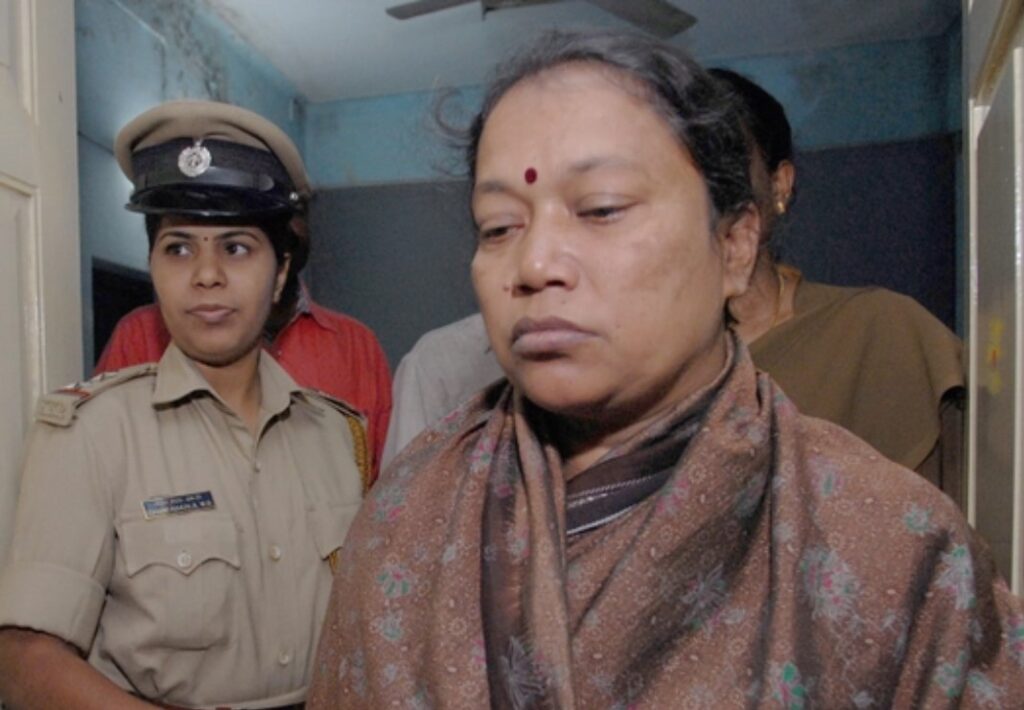
Among the few names that shook India’s collective conscience in the 2000s, “Cyanide Mallika” (born K. D. Mallika) stands out for both her cold-blooded precision and gender-defying criminal psychology. Between 1999 and 2007, she lured, robbed, and killed multiple women across Karnataka using cyanide-laced water — a weapon as silent as it was deadly. Her story is not just about murder; it is about deception, greed, and the mask of faith that hid a predator in plain sight.
Early Life and Background
Mallika, whose full name is K. D. Mallika (Koodli Devamma Mallika), was born in Karnataka, India, in a modest family that struggled financially. Details about her early life remain sketchy, but what’s known paints the portrait of a clever, manipulative woman who could charm, empathize, and persuade with unnerving ease.
She was married to a man named Sadananda, but her marriage soon fell apart. Struggling for stability, she took refuge in religion and spiritual devotion, often frequenting temples and ashrams. This pious façade became the cornerstone of her crimes — she found in faith both her disguise and her hunting ground.
Genesis of a Serial Killer
The late 1990s and early 2000s saw a wave of temple robberies and unexplained female deaths across the districts of Mysuru, Dakshina Kannada, and Udupi. Police initially dismissed many cases as suicides or accidental poisonings until a chilling pattern began to emerge:
Each victim was a devout woman, often visiting temples, and each death followed encounters with a seemingly kind stranger — Mallika.
Her modus operandi was chillingly simple and effective:
- Identify Vulnerable Victims: She targeted middle-aged women who were emotionally fragile — widows, unmarried women, or those seeking spiritual solace.
- Gain Trust: Mallika approached them in temples, posing as a religious devotee or matchmaker, offering help in resolving personal or marital issues.
- Lure to a Temple Visit: She convinced them to accompany her to another temple to perform a special ritual or meet a spiritual guru.
- Administer Cyanide: Once secluded, she offered them holy water or prasad laced with potassium cyanide.
- Robbery and Disposal: After the victim collapsed, Mallika robbed jewelry, cash, and other valuables, then left the body in restrooms, lodges, or temple premises — blending the scene into the spiritual setting.
The Signature: Cyanide as Her Weapon
Cyanide became Mallika’s signature.
A colorless, fast-acting poison, it causes near-instant death by blocking oxygen use in the body, leaving victims appearing almost peaceful — often mistaken for natural causes.
Investigations later revealed that she obtained the poison from goldsmiths, who used cyanide for gold purification. Her clinical precision in dosage and timing suggested both planning and experience, not impulsive violence.
Unlike many serial killers motivated by rage or trauma, Mallika’s murders were calculated for profit. Her motive was greed, but her technique mirrored psychopathic calmness — devoid of empathy yet disguised by devotion.
Victim List and Geographical Spread
Police linked Mallika to at least sixteen murders between 1999 and 2007, though she confessed to more. Her crimes spanned multiple districts in Karnataka:
- Dakshina Kannada (Mangalore region)
- Mysuru
- Hassan
- Tumakuru
- Udupi
Each location had similar hallmarks — a temple visit, a trusting woman, a cyanide offering, and a body found hours later.
Victims often carried gold ornaments, which Mallika later sold to local jewelers. Her ability to travel across towns, maintain anonymity, and adapt her story for each victim made her nearly invisible to law enforcement for nearly a decade.
The Investigation and Arrest
The web began to unravel in 2007 when the death of a woman named Nagaveni raised suspicion. Police noted uncanny similarities with earlier temple deaths — all victims were found with jewelry missing and frothing at the mouth, a telltale sign of poisoning.
Authorities connected the dots between these temple deaths and the appearance of one recurring witness: a friendly, middle-aged woman known as Mallika.
After months of surveillance, Mallika was arrested in 2007 near Kundapura. Her interrogation stunned even hardened officers. She admitted, with unsettling composure, that she had killed multiple women, adding,
“It was easy. They trusted me completely.”
Police recovered stolen jewelry, fake identity documents, and small vials of cyanide from her possession.
The Trial and Convictions
The trials against Cyanide Mallika unfolded over several years. The first major conviction came in 2012, when she was found guilty of the murder of Nagaveni and sentenced to death by a trial court in Mangalore. Subsequent appeals reduced her sentences to life imprisonment.
By 2020, she had been convicted in six murder cases and acquitted in a few others due to lack of direct evidence.
Each conviction carried life imprisonment, to be served consecutively — effectively ensuring she would never be released.
The Karnataka High Court later commuted her death penalty, emphasizing the absence of eyewitnesses and her gender, but upheld the gravity of her crimes.
Psychological Profile: The Mind of a Manipulator
Criminologists describe Mallika as a rare female serial killer in India — distinct from impulsive or emotionally driven offenders.
Her psychopathy manifested as charm and cunning, not overt aggression.
She blended faith, gender, and trust into a weaponized persona.
Psychologists analyzing her behavior noted:
- High manipulative intelligence: She could assess emotional weaknesses quickly.
- Absence of remorse: She spoke about murders as “necessary acts.”
- Superficial charm: She presented herself as helpful, maternal, or spiritual.
- Calculated control: Each murder was premeditated, with clear profit motive and risk assessment.
Her gender also helped her evade suspicion — society rarely imagined a pious woman as a cold serial poisoner.
Cultural Impact and Media Coverage
The case of Cyanide Mallika gripped Indian media for years. She was dubbed the “female Charles Sobhraj” by tabloids for her cunning and cross-district operations.
Television channels aired reenactments, crime shows like Crime Patrol and Savdhaan India dramatized her story, and documentaries explored her unique criminal psychology.
Her case also reignited debates in Indian criminology about:
- The underrepresentation of female serial killers in law enforcement studies.
- The gendered blind spots in police investigations.
- The role of religious spaces as unsuspected crime scenes.
Academically, Mallika’s case is studied in Indian criminal psychology courses as a classic example of instrumental killing — murder for gain, without emotional involvement.
Life in Prison
Now in her 60s, Mallika serves her multiple life sentences at the Central Prison in Bengaluru. Reports from prison staff describe her as calm, deeply religious, and unrepentant.
She continues to read spiritual texts, reportedly claiming that she prays daily “for forgiveness” but never admitting remorse.
She remains an object of fascination for journalists and criminologists — a living example of how faith, femininity, and fatality intertwined in one of India’s most unusual criminal minds.
Conclusion
The story of Cyanide Mallika is a grim intersection of faith and deception — a reminder that evil can wear a benign smile.
In a patriarchal society where women are rarely viewed as predators, she shattered assumptions, proving that manipulation and greed know no gender.
Her legacy endures as both a cautionary tale and a haunting case study of how trust, when misplaced, can turn lethal.
Want to read a bit more? Find some more of my writings here-
Book Review: The House Next Door Book
Top 10 Anniversary Celebration Ideas That Aren’t Dinner
February 4 – World Cancer Day: Turning Love Into Action
I hope you liked the content.
To share your views, you can simply send me an email.
Thank you for being keen readers to a small-time writer.