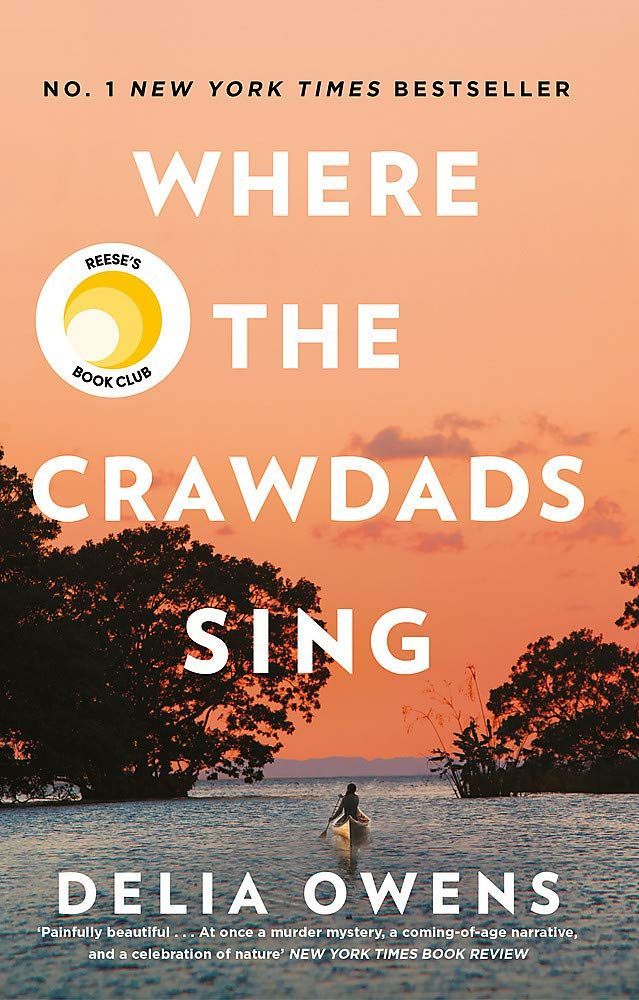
When I first came across Where the Crawdads Sing, I didn’t know I was stepping into a world that would haunt me long after the final page. This novel by Delia Owens is not just a story — it’s a lyrical journey into nature and survival, memory and betrayal, loneliness and redemption. On Riya’s Blogs, I want to share with you everything that makes this book unforgettable: its characters, its wild marshland setting, its heartbreaking beauty, and its shadowed mysteries.
Setting the Scene: The Marsh and the “Marsh Girl”
From the very start, Where the Crawdads Sing throws you into the thick, damp marshes of a fictional coastal town called Barkley Cove, somewhere along the North Carolina coastline.
Here, amid reeds and tidal waters, lives a little girl named Kya Clark — though the townspeople soon begin to call her “the Marsh Girl.” That name, Marsh Girl, carries both scorn and mystery: to them, she is odd, unkempt, wild — partly feared, partly pitied. Yet for Kya, the marsh is far more than a prison or a mark of shame. It is home.
As a child, Kya is abandoned — first by her mother, then by her siblings, and eventually by her father. Left utterly alone, she’s stripped of the comforts of family, society, and civilization. But instead of giving in to despair, Kya turns to the only refuge she knows: nature. The marsh becomes not just her physical home, but her teacher, protector, and companion.
She learns to read the tides, to listen to gulls, to collect shells, feathers, and the minutiae of marsh-life. She carries a knapsack she uses to gather shells, feathers, and other treasures, and with watercolors left behind by her mother — the only remnants of her past — she begins to document the world around her.
In this wild solitude, Kya becomes more than a “girl from the marsh.” She becomes part of the marsh. The title — Where the Crawdads Sing — echoes this truth. As it’s explained in the story, “crawdads” (crayfish) obviously don’t sing. The expression is metaphorical — a poetic way to describe a remote place so wild and untouched that one might imagine the mud and water humming secrets. For Kya, that place where the crawdads sing becomes her refuge, her identity — a wild heart in a world that refuses to understand her.
Childhood, Abandonment, and Survival
The early chapters of Where the Crawdads Sing are fraught with pain. Kya’s mother leaves, unable to endure an abusive, alcoholic father. Her siblings follow, one by one. And at a tender age, Kya is left utterly alone.
As if being deserted by her family wasn’t cruel enough, the world outside offers no solace. When she briefly attempts school, she is ridiculed and called names: “swamp rat,” “dirty,” “marsh trash.” The town rejects her.
Yet, in that harsh rejection, Kya’s spirit hardens — not into bitterness, but into survival. She learns to fish, to catch mussels, to cook grits. She makes a living from the land and water — selling mussels and smoked fish to a local Black couple, Jumpin’ Madison and his wife Mabel, who become her unlikely protectors and friends.
With no formal education, Kya is forced to teach herself. She watches the tides. She studies gulls. She draws, she writes, she catalogs shells — building a deep, instinctive knowledge of the marsh. In the loneliness and abandonment, her connection with nature becomes her anchor: her identity.
This isolation shapes not only her survival tactics — but also her view of human relationships, trust, and vulnerability.
Innocence, Loneliness — and a Brief Glimmer of Connection
Years pass. The marsh remains her world, but her longing for human connection never fades. Into her life enters Tate Walker, a gentle boy from town (and friend of her brother) who shows kindness rather than scorn. He gradually teaches her to read and write — skills she never even dreamed of having.
Tate becomes Kya’s first real human connection — a glimmer of hope that maybe, just maybe, she doesn’t have to remain alone forever. But life is never simple in Where the Crawdads Sing. Tate leaves for college, promising to return. He is courting the idea, but the weight of the marsh, of her reputation, of her distrust in people — all of it makes it almost impossible for Kya to believe in love.
The marsh, at that point, feels safer than any human heart.
Love, Betrayal, and the Ghost of a Necklace
Even as Kya retreats deeper into solitude, she catches the eye of Chase Andrews — a popular, handsome boy from town. Against her better judgment, a relationship develops. In the world outside, Chase is admired, envied. To many, a dream come true. But the truth is always darker.
Their relationship quickly reveals the sharp edges of trust and betrayal. On a date, Chase attempts to assault Kya. He lunges at her — trying to force intimacy she doesn’t want. Even though she pushes him off and escapes, the horror lingers. But society’s gaze isn’t kind or understanding. Report it — and she knows she’ll be judged, blamed, dismissed. So she remains silent.
Still, despite the assault, Kya accepts his apology. She tries to trust again. For a time, Chase seems charming and sincere. To prove a point — or maybe to draw a connection to the marsh — Kya gifts him a necklace made from a shell she treasures. It’s a meaningful symbol: her world, her identity, offered vulnerably — a bridge between marsh and town.
But, hauntingly, the necklace becomes central to what comes next.
The Mystery: Murder, Accusations, and Trial
Time moves on. Tate, back from college, tries again to reconnect with Kya. But scars run deep. Pain, loneliness, betrayal — they’ve carved walls around her heart. Meanwhile, Chase Andrews remains in her life, at times gentle, at times predatory.
Then — the shock. One day, Chase is found dead beneath an old fire tower in the swamp. His body lies in the mud; there are no footprints, no fingerprints. The necklace — the same one Kya gave him — is missing.
Suddenly, the Marsh Girl becomes the prime suspect. All eyes turn to her. Gossip spreads. Prejudice that was always simmering under the surface boils over. A town that long dismissed her as weird, wild, unworthy — now brands her a murderer.
Kya is arrested, thrown into jail. For two months, she lives under the weight of suspicion, isolation, and fear. Her past, her solitude, her weirdness — everything the town ever ridiculed — is used as proof against her.
Yet, when the trial comes — a glimmer of hope. With a skilled lawyer defending her, the absence of concrete evidence (the missing necklace, no fingerprints, no footprints) leads to her acquittal. The jury — perhaps swayed by reasonable doubt, or by the implausibility of the town’s prejudice — declares her not guilty. Kya walks free.
But innocence, she quickly learns, doesn’t wash away suspicion — not in Barkley Cove. Not ever.
Redemption, Nature, and the Hidden Truth
After the trial, something shifts. The walls around Kya begin to crumble — but only a little. She reconnects with Tate: they confess their love, and decide to build a life together, living quietly in her shack by the marsh. Over time, Kya uses her deep knowledge of the marsh to publish books — detailed studies of shells, seabirds, marsh flora and fauna. Through her art and writing, she transforms pain and solitude into something beautiful and healing.
In a quiet act of reclamation, she restores the shack, pays off debts, and gradually builds a life — one that merges her wild heart with a fragile human connection. The marsh remains her soul, Tate becomes her anchor, and nature becomes her lifelong companion.
Then, decades later — in her mid-sixties — Kya dies peacefully, in the world she made her own, surrounded by marsh, memory, and quiet acceptance.
After her death, a final secret emerges. Hidden beneath the floorboards in her shack, Tate finds a box of poems written under a pseudonym — Amanda Hamilton. Among them is a poem that appears to describe the death of Chase Andrews. Alongside the poems lies the shell necklace — the very one she gave him. The implication is chilling: maybe Kya did it after all. Maybe justice, in her eyes, was a survival instinct — as natural as the marsh’s tides, as inevitable as the crawdads themselves.
In that final twist, Where the Crawdads Sing does something daring: it refuses to wrap up neatly. It asks you to question justice, prejudice, innocence, and what survival demands.
Themes Woven Through the Marsh
What makes Where the Crawdads Sing more than a simple murder mystery? Why does it linger in your mind, even after you close the book? Because it is poetic, messy, dark, and achingly alive.
Nature as Sanctuary — and as Character
The marsh isn’t just a backdrop. It’s alive. It breathes. It shapes Kya. It protects her. It teaches her. In its tides and mud and mud-laced waters, she finds identity, solace, purpose. The novel turns the wild into a sanctuary — even a teacher. It reminds us how nature, in its silence and storms, can bring both grief and healing.
Isolation, Loneliness, Identity
Kya’s isolation — first by family, then by society — is brutal. But instead of breaking her, it forms her. She becomes self-sufficient, observant, wise in ways others can’t understand. Her identity as the Marsh Girl is both a curse and a kind of freedom. Where the Crawdads Sing shows how loneliness can birth strength, awareness, even artistry.
Prejudice, Judgment, Human Cruelty
The people of Barkley Cove don’t simply ignore Kya — they fear her, ostracize her, mock her. As soon as tragedy strikes, they hardly need evidence before casting blame. The novel lays bare how society judges what it doesn’t understand, how fear breeds cruelty, and how innocence can be buried under prejudice.
Survival, Resilience, and Reinvention
Kya’s life is essentially a story of survival. From a traumatized, abandoned child to a published naturalist — it’s almost an unnatural arc. But in that surviving, there’s reinvention. She doesn’t just survive the marsh, she masters it. She translates pain into knowledge, suffering into art, solitude into purpose.
Justice, Revenge, and Ambiguity
Finally, the question looms: Did Kya kill Chase Andrews? Was it revenge? Was it accidental? Was it a dark justice? The ending refrains from giving a neat answer. Instead, it hands the reader ambiguity — and asks what real justice means when the system, society, and prejudice already convict you before evidence.
Why Where the Crawdads Sing Strikes a Chord (and Fragile Hearts)
I think Where the Crawdads Sing resonates so deeply because it touches primal things: the longing to belong, the ache of abandonment, the fierce craving for dignity, and the fragile hope for love. It shows that even in the most unforgiving environments — whether a swamp or a small-minded town — life persists. Wild, messy, imperfect — but persistent.
Kya’s story is heartbreaking. It’s unfair. It’s full of cruelty. But it is also full of wonder: wonder at gulls crying overhead, at shells glinting in moonlight, at the hush of marshes at dawn, at the secret languages of tides. The novel doesn’t sugarcoat hardship — but it reveals beauty in scars.
On Riya’s Blogs, I hope readers who haven’t picked up the book yet will see this not just as a summary, but as an invitation. An invitation to immerse yourself in marsh-water, to feel the salt spray, to listen to silence, to question justice, and to wonder at the messy complexity of human hearts.
If you read Where the Crawdads Sing knowing nothing, you’ll experience shock. If you read it knowing parts of the plot, you might still be caught off guard by how tender and cruel life can be — often at the same time.
My Take: What Stayed With Me
- The marsh described in Where the Crawdads Sing stays alive in my mind — not as a setting, but as a character: unpredictable, nurturing, dangerous, beautiful.
- Kya’s resilience — as a child surviving on mussels and tidewater, as a woman trying to trust, as an artist giving voice to silence — is a powerful testament to human will and the healing power of nature.
- The ambiguity at the end — the hidden poem, the necklace, the unspoken truth — lingers like marsh mist. It doesn’t let you forget. It doesn’t let you judge gently. It forces you to hold contradictions.
- And finally: the story suggests that sometimes the wildest places — where the crawdads sing — are not the ones to escape from, but the ones to belong to.
For Whom This Book Speaks — and What to Expect
If you love nature writing, haunting landscapes, emotionally complex characters, and stories that don’t bow to easy endings — Where the Crawdads Sing will speak to you. It’s for those who don’t mind pain, who don’t expect perfection, who are ready to love a character not because she’s flawless, but because she survives.
But fairness demands a caveat: some readers (on forums like Reddit) find the book overhyped, or feel the pacing slows in places, especially during the trial. If you expect a neat whodunit or a happily ever after, you might be disappointed. This story doesn’t wrap up all loose ends. It leaves scars, questions — and a quiet ache.
Still, I found that to be its greatest strength. It doesn’t reassure you: it challenges you. It doesn’t comfort you: it unsettles you. It doesn’t neatly categorize you: it leaves you wondering — about justice, love, identity, nature, and survival.
Final Thoughts: Why Where the Crawdads Sing Matters
In a world filled with polish, convenience, and curated lives, Where the Crawdads Sing feels like a wild breath. It reminds us what it means to be human in the raw: vulnerable, afraid, hopeful, wounded — yet alive. It shows that sometimes being “wild” isn’t a curse, but a kind of power. That isolation can sharpen you. That nature — with all its unpredictability — can heal you. That love and trust are fragile, but redemption can come, sometimes from the least expected places.
On Riya’s Blogs, I believe this book stands as a testament — to resilience, to memory, and to the wild hearts that refuse to be quieted. If you haven’t read it yet, consider this your invitation. Go as far as you can — way out yonder — where the crawdads sing.
Want to read a bit more? Find some more of my writings here-
60 Courage Quotes to Remind You to Be Brave Anyway
50 Philosophy Quotes That Question Everything and Say So Much
70 Attitude Quotes That Prove You Don’t Need Approval
I hope you liked the content.
To share your views, you can simply send me an email.
Thank you for being keen readers to a small-time writer.